A Book Dedicated to Einsteins Mistakes
Dear parents, I am sorry to bring this disgrace on the family, but I am pregnant. Marguerite.
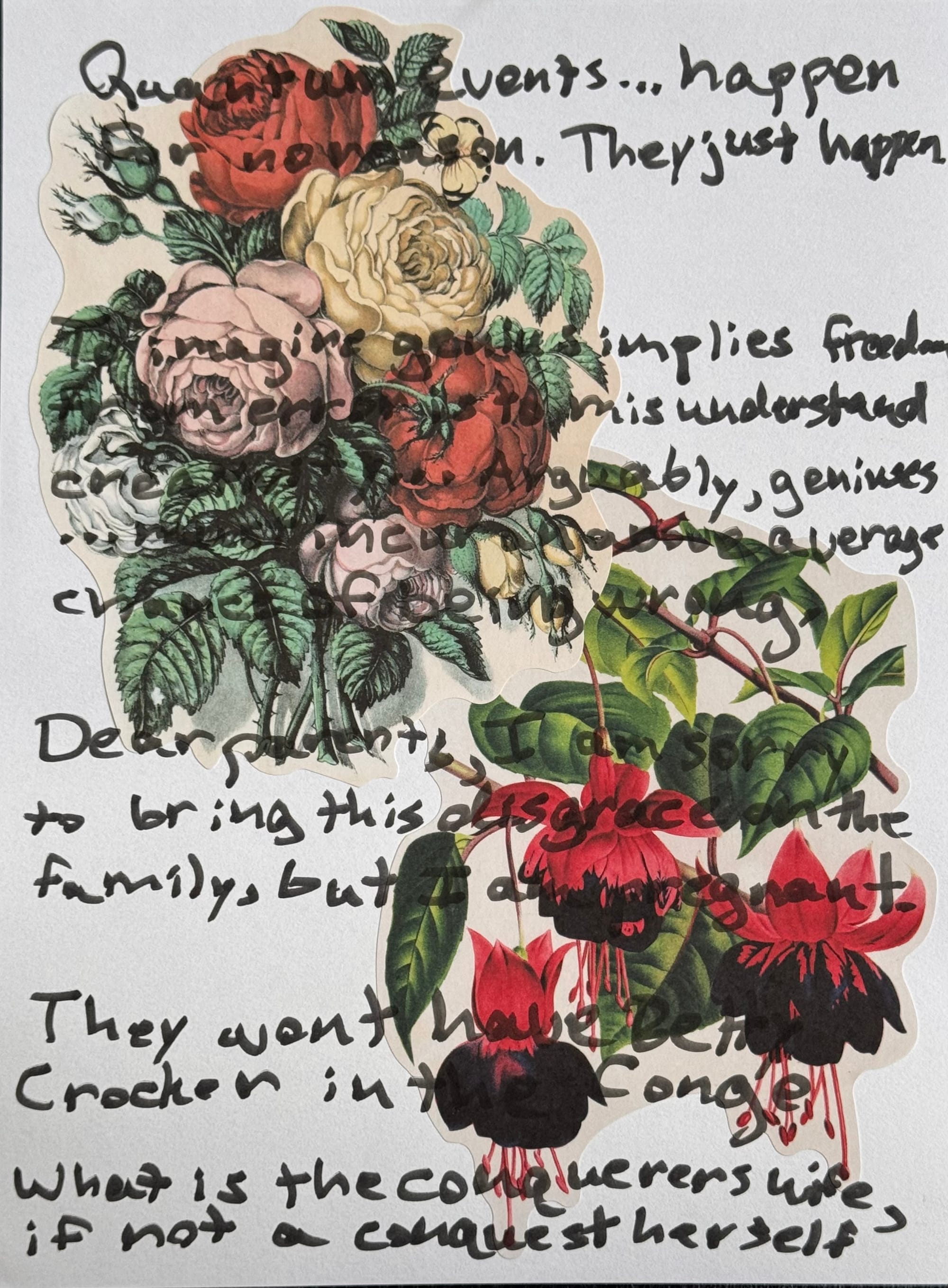
When a pin is balanced vertically on its point and allowed to fall, the direction in which it topples is random. Or is it? Suppose we could measure its state before toppling with extreme accuracy. Then we might find that it wasn’t perfectly upright to begin with, so we have introduced a bias that decides the direction. So we get a better method of alignment. But now we see that the pin itself isn’t perfectly symmetrical: there’s slightly more mass on one side, and so that is weighed down more. So we make the pin perfectly symmetrical. But now we can detect exactly how many air molecules strike it from different directions, and find that in each experiment there’s a very tiny imbalance that pushes the pin one way or another. So we let it topple in a vacuum – and so on. The point is that what seemed random turns out in each case to have a definable cause that produced a bias. Apparent randomness was simply a consequence of our lack of knowledge about the system. This kind of randomness is easy to accept, because we may rest assured that there’s a causal logic to what we see even if we can’t get at it: in short, things happen for a reason. But the probabilistic nature of the Schrödinger equation, which predicts only the likelihood of different experimental outcomes, leaves it offering no reason why one specific outcome is observed instead of another. In effect, it says that quantum events (the radioactive decay of an atom, say) happen for no reason. They just happen. That sounds like a terribly unscientific thing to say, and seems to go against the grain of everything that scientists and natural philosophers have striven to achieve since well before the time of Isaac Newton: to explain the world. Quantum events don’t appear to have an explanation as such – one in which definable causes lead to specific effects – but only a probability of occurrence. This is what Einstein found unreasonable. Who can pretend that it isn’t?
--Beyond Weird - Philip Ball
If the universe isn't deterministic, does that mean that all of our efforts are for naught?
Albert Einstein seemed resigned with good grace to a widespread determination to prove him wrong. An endless stream of cranks has attempted to ‘disprove’ Einstein’s theories of relativity ever since they were first published, and Einstein responded patiently to some of the untutored correspondence he received that claimed to find errors in his work. Obviously, if you could show that Einstein had erred then you would be revealed as a genius of the highest degree, and there was (and still is) no shortage of applications for that position. It is a sign of supreme intellectual renown when even your ‘errors’ and ‘blunders’ are celebrated, and when announcements that you have been proved ‘wrong’ make newspaper headlines. But actually Einstein was ‘wrong’ about many things. He made a few trivial lapses in his calculations. He famously fudged his theory of general relativity to avoid its prediction of an expanding universe, just a few years before astronomers found that to be precisely the state of the cosmos. Even his many proofs of the celebrated E = mc2 contained little gaffes. Heck, there’s an entire book enumerating Einstein’s mistakes.*1 None of this has the slightest bearing on Einstein’s status as the greatest scientist of the twentieth century. To imagine that genius implies freedom from error is to misunderstand the nature of creativity and insight. Arguably, geniuses (whatever that means) must incur an above-average chance of being wrong.
--Beyond Weird - Philip Ball
Every single thing seems to have some kind of competitive streak, even if the competition is relegated to physicist nerds trying to prove other physicist nerds wrong.
Cookery supplies the popular metaphor: if we add the baking powder after we have mixed the other ingredients and baked the cake, we get a different result from adding it before baking (I have tried this experiment, so I can verify the statement). I like to think that a better, if peculiarly British, analogy is supplied by making tea. Adding the milk to the cup before pouring the tea gives a different quality of brew to adding the milk to the tea in the cup. It might seem improbable, but connoisseurs swear it is true (I believe them), and there may be good scientific reasons for it. (They are not, I should add, quantum reasons.)
--Beyond Weird - Philip Ball
Measurement in the classical physics world is often communicative, meaning that if you measure a to b and b to a, you get the same distance. But in the quantum world, that's not necessarily the case. Measurement has a direct impact on the experiment itself and the results that you receive.
There is (we’re told) a fuzziness to the quantum world that prevents us from knowing everything about it in absolute detail. Ninety years ago, Werner Heisenberg articulated this with his famous Uncertainty Principle. But Heisenberg’s discovery is often misunderstood. It might be taken to imply either that nothing in the quantum world can be measured exactly (perhaps because we can’t help disturbing what it is we want to measure?) or – a more sophisticated misconception – that if we want to measure one thing very accurately then we have to accept a commensurate blurring in the values of everything else. Neither idea is correct. We can’t blame these misunderstandings on a woeful lack of public science literacy. The Uncertainty Principle actually is rather technical, and it’s not surprising that non-specialists may miss its message. The problem is compounded by the catchy name. It’s a name that chimed with the insecure times in which Heisenberg deduced his result in 1927: between the wars, with Germany reeling from hyperinflation and political crises, and with Nazism on the rise. To make things worse, even Heisenberg did not fully understand the implications of what he had stumbled across. He couched the Uncertainty Principle in terms both hazy and apt to mislead, and which have left physicists arguing about it even today. He made trouble for himself. Heisenberg’s Uncertainty Principle is not exactly a constraint on how precisely we can make a measurement of some quantum property. Rather, it constrains how precisely the property we want to know about exists at all. It might have been better christened the Unknowability Principle – better still, the Unbeability Principle – although doubtless that would have spawned a mysticism of its own.
--Beyond Weird - Philip Ball
So much of science, we want to believe, is this objective reality descriptor. But in fact, because we use language and because science is always done in a time where humans, being the political creatures we are (a la Aristotle) , find ways to leverage science to get across political aims. We're currently seeing this with the technology of language models vs the perception of what artificial intelligence is in the public sphere, for example.
This book is dedicated to MY SON, GUY JOHNSON, AND ALL THE STRONG BLACK BIRDS OF PROMISE who defy the odds and gods and sing their songs
--I Know Why the Caged Bird Sings - Maya Angelou
SING YOUR SONGS BIRDS!!!! SING!!!!
As my sixth month approached, Mother left San Francisco for Alaska. She was to open a nightclub and planned to stay three or four months until it got on its feet. Daddy Clidell was to look after me but I was more or less left on my own recognizance and under the unsteady gaze of our lady roomers. Mother left the city amid a happy and cheerful send-off party (after all how many Negroes were in Alaska?), and I felt treacherous allowing her to go without informing her that she was soon to be a grandmother. Two days after V-Day I stood with the San Francisco Summer School class at Mission High School and received my diploma. That evening, in the bosom of the now-dear family home I uncoiled my fearful secret and in a brave gesture left a note on Daddy Clidell's bed. It read: Dear Parents, I am sorry to bring this disgrace on the family, but I am pregnant. Marguerite. The confusion that ensued when I explained to my stepfather that I expected to deliver the baby in three weeks, more or less, was reminiscent of a Molière comedy. Except that it was funny only years later. Daddy Clidell told Mother that I was “three weeks gone.” Mother, regarding me as a woman for the first time, said indignantly, “She's more than any three weeks.” They both accepted the fact that I was further along than they had first been told but found it nearly impossible to believe that I had carried a baby, eight months and one week, without their being any the wiser.
--I Know Why the Caged Bird Sings - Maya Angelou
Maya Angelou is an expert at delivering the perfect amount of information her audience needs to hear in her real life and in her book.
The world had ended, and I was the only person who knew it. People walked along the streets as if the pavements hadn't all crumbled beneath their feet. They pretended to breathe in and out while all the time I knew the air had been sucked away in a monstrous inhalation from God Himself. I alone was suffocating in the nightmare. The little pleasure I was able to take from the fact that if I could have a baby I obviously wasn't a lesbian was crowded into my mind's tiniest corner by the massive pushing in of fear, guilt and self-revulsion. For eons, it seemed, I had accepted my plight as the hapless, put-upon victim of fate and the Furies, but this time I had to face the fact that I had brought my new catastrophe upon myself. How was I to blame the innocent man whom I had lured into making love to me? In order to be profoundly dishonest, a person must have one of two qualities: either he is unscrupulously ambitious, or he is unswervingly egocentric. He must believe that for his ends to be served all things and people can justifiably be shifted about, or that he is the center not only of his own world but of the worlds which others inhabit. I had neither element in my personality, so I hefted the burden of pregnancy at sixteen onto my own shoulders where it belonged. Admittedly, I staggered under the weight.
--I Know Why the Caged Bird Sings - Maya Angelou
In her memoir, Maya takes on so much and puts so much weight on her shoulders and is forced to grow up so fast, it really makes me think of how we can actually bear much more weight than we think that we can. And that what feels like insurmountable odds rarely are. And that even the worst-case scenario of death is fine, because really everyone's done it before anyway (even if their life was going really well after all.).
WE CAME FROM BETHLEHEM, Georgia, bearing Betty Crocker cake mixes into the jungle. My sisters and I were all counting on having one birthday apiece during our twelve-month mission. “And heaven knows,” our mother predicted, “they won’t have Betty Crocker in the Congo.” “Where we are headed, there will be no buyers and sellers at all,” my father corrected. His tone implied that Mother failed to grasp our mission, and that her concern with Betty Crocker confederated her with the coin-jingling sinners who vexed Jesus till he pitched a fit and threw them out of church. “Where we are headed,” he said, to make things perfectly clear, “not so much as a Piggly Wiggly.” Evidently Father saw this as a point in the Congo’s favor. I got the most spectacular chills, just from trying to imagine.
--The Poisonwood Bible - Barbara Kingsolver
If you can go to a desert island with one item and you decide to bring Betty Crocker...
What is the conqueror’s wife, if not a conquest herself? For that matter, what is he? When he rides in to vanquish the untouched tribes, don’t you think they fall down with desire before those sky-colored eyes? And itch for a turn with those horses, and those guns? That’s what we yell back at history, always, always.
--The Poisonwood Bible - Barbara Kingsolver
Much of the vows in a traditional heterosexual marriage, even to today, are kind of along the lines of giving the woman away to the man, even though we don't readily believe that anymore in modern society. At least I don't think there are some people who do. It's interesting that those words are still used in a way because they haven't been able to be replaced by words that make more sense and represent the function of what marriage is as a legal construct vs. what it is as a love construct. Basically the idea of ownership vs. companionship.
IT ALL BEGINS in what some remember as a kind of paradise. The Iberian Peninsula, cut off from Europe by nearly impassable mountains, and spared the long darkness of northern barbarian domination, had been the locus of a rich intermingling of Moorish, classical, Christian, and Jewish cultures. Three geographically distinct regions pollinated one another economically, intellectually, and aesthetically: the seafarers in the west, the land tenders and silk makers in the south, and the castle dwellers and townspeople of the center and north. A common culture resulted from the balance of these various regions, and it even included an anomalous mixing of religious influences. Spanish historians refer to this period as convivencia, a word loosely translated as “coexistence,” but one implying a far more creative interaction than that of, say, the United States and the Soviet Union during their time of coexistence. In Córdoba, for example, under the rule of the Islamic caliphate, Christians were welcome to hold their worship services in the Great Mosque, and they did so. It was one of the grand building complexes in Europe, dating to the eighth century, proudly situated by a noble river, above an ancient Roman bridge. The mosque still stands, with its dramatic horseshoe arches and arcades, stone window grilles and battlements, although all of the Moorish elements are overshadowed now by the Christian cathedral that was built on top of the mosque in the sixteenth century.
--Constantine's Sword - James Carroll
I had arrived at the seminary with a small cache of books, which I was resolved to read in the spirit of self-improvement. I have no idea how I had made my selection of titles, but one of the books was The Age of Reason by Jean Paul Sartre. Somehow my possession of this philosophical novel came to the attention of the seminary rector, who summoned me. He demanded to know if I had been reading Sartre. I recall that the first phase of my panic was tied to shame at being unable to understand the work of the French existentialist. My intellectual mulishness would be exposed. Then I realized the rector had read as little as I. He confiscated the book, announcing it as “on the Index.” The word carried a jolt, evoking an image of heretics burning at the stake. The Index was the devil’s own library, a store of ideas too dangerous to know about. The Index? Me? But what really seemed amazing was that books on the Index were available in paperback. The Index of Forbidden Books, dating to the sixteenth century, was the Inquisition’s list of publications deemed to be heretical. Catholics could not read these books without formal dispensation. The Index was not abolished until 1966. The Roman Congregation of the Inquisition, formally called the Holy Office, was renamed in 1965, becoming the Congregation for the Doctrine of the Faith. The prefect, or head, of that congregation today is Cardinal Joseph Ratzinger, to whom we have already referred. Ratzinger is the putative author of Canon 1436. I of the Code of Canon Law, which states, “One who denies a truth which must be believed with divine and Catholic faith, or who calls it into doubt, or who totally repudiates the Christian faith, and does not retract it after having been warned, is to be punished as a heretic or an apostate with major excommunication.”
--Constantine's Sword - James Carroll
One of the freedoms we often take for granted is the adult agency over literacy to read whatever we decide is worth reading. However, the “indexes” of today are largely the existence or non-existence of a book on a Barnes and Noble bookshelf or an Amazon Kindle shelf as opposed to what is banned by some secular or religious organization.
In a sense, we are now dealing with self-published AI-generated book curation that while aren't directly counterproductive to any narrative of a power structure, they are still very powerful in their own right.
By definition, Jews, the original and quintessential dissenters, call into question the supremacist universalism of claims made for Jesus Christ. In the present age, with its overlay of politesse, the depth of this conflict, and the danger of it, are obscure. But the history of the time when its structures were erected—structures that John Paul II has sworn himself to uphold—embodies a tragic warning. Beginning with the Fourth Lateran Council’s (1215) resolve to eliminate heresy, and Pope Gregory IX’s Excommunicarnus (1231), which set up roving Dominican and Franciscan ecclesiastical courts, the early Inquisition had pursued its program intermittently, with no central apparatus. With Pope Innocent IV’s decree (1252), torture was permitted. Boniface VIII’s absolutism (1302) led to the consolidation of both the ideology and the institution. The coming of the Spanish Inquisition in the fifteenth century, as we shall see, would brace the soul of Europe before becoming planted in Rome itself. The cruelty and narrowness of the Roman Inquisition are linked in the public mind with the Galileo case (1633), but that was tame compared to what had gone before. This unprecedented institution, whose abuses are now roundly denounced by all,16 intended only to uphold the oneness of the Church. Is it possible to repudiate the Inquisition without questioning what it sought to defend? Beyond its methods and abuses, what about the broader impact of the Inquisition on the Catholic mind? In fact, the Inquisition would fatally undermine the positive side of the long-standing Catholic ambivalence toward Judaism, and would fundamentally change the Catholic attitude toward “the Jewish-born,” in the careful phrase a newspaper applied to Bob Dylan. The Inquisition would spawn the idea of “Jewish blood.”
--Constantine's Sword - James Carroll
Mrs. Watkins, despite being in her 60s, was in remarkable shape. They say black don’t crack, and Mrs. Watkins was the living embodiment of that timeless adage. One could easily mistake her for being in her mid-40s. Guess you can thank her youthful appearance to yoga, Zumba and cycling classes four to five times a week at her local LA Fitness on top of her semi-vegetarian diet. Standing at around 5’5 and weighing no more than 125 pounds, Mrs. Watkins eerily resembled a younger Lena Horne. She had short and wavy black hair with streaks of gray. Although she wasn’t super-light skinned like the famed and legendary black actress, her hue was Creole red due in part to her Louisiana ancestry.
--This Hoe Got Roaches in Her Crib - Quan Millz
Frequent streams of gunshots, sobbing mothers, crackhead fights and roaring bass heavy trap music was the soundtrack to life in Englewood. Irrespective of Chicago’s brutal weather, armies of dope boys and gang members roamed the streets, aimlessly living life, setting themselves up to be future murder statistics. Nearly fifty percent of the residents in the area lived at or below the poverty rate. If one were to take a drive around the area, one would notice that virtually every other house was abandoned, marked with red X signs on their molded wooden doors. Tall, uncut shrubbery gated off many of these run-down houses and flats; dereliction their sole occupant. The Chicago Fire Department years ago started this program called the Chicago Red X Program that was designed to place red X placards on vacant houses and buildings, alerting first responders and firefighters that essentially these marked properties were beyond fucked up. Enter at your own risk. Shit, truth be told, the entire neighborhood needed a big red X on it. Dwell there at your own risk. Sad as it may seem, just generations ago Englewood was once a bourgeoning black community filled with prosperous middle class black families pursuing the American dream. Nonetheless, like so many other black communities across the United States, Englewood went through major decline in the 70s and 80s, and now the area was a living nightmare of urban desolation and decay.
--This Hoe Got Roaches in Her Crib - Quan Millz
{prince of egypt x}
Curious as he was, Austin stopped what he was doing and slowly trekked over to Dr. Sterling. “Hey, Dr. Sterling. I hate to be nosey, but what happened to my brother?” Dr. Sterling exhaled… “Early this morning his fiancée and his daughter were unfortunately caught in crossfire of a shootout that happened on Lake Shore Drive.” “Well, is she ok, is everything gonna be alright?” Austin asked, although his street intuition informed him based on DeMario’s breakdown she probably didn’t make it. “Unfortunately…no. But his fiancée is in critical condition.” Austin, a bit disturbed from hearing the news, covered his mouth with his right hand and shook his head in shock and disbelief. “Man, I’m so sorry to hear that. That’s some crazy ass shit to have happened today. She was supposed to be here, right?” “Yes…That was his only daughter…” “Fuckkkkk,” Austin continued shaking his head as he lowered it. “Count your blessings, Austin…When your daughter gets here, you need to love on her as much you can because you never know what life will have in store for you.” Austin couldn’t say anything in response. He just nodded in affirmation to her statement and walked away. It was completely fucked up for something like that to happen on what was supposed to be splendidly happy and beautiful early evening, Austin thought as he continued to assemble chairs around tables.
--This Hoe Got Roaches in Her Crib - Quan Millz
Life is neutral, we make it kind or cruel.
Austin’s scheduled release date was in a month – July 1st. With less than a month left before getting released, Austin was doing his best to ensure he’d never come back to jail ever again. Lesson fucking learned. One of the first things Austin had plans on doing after getting out of jail was going to college to get his bachelor’s degree. Before his father died, Austin made a promise that he would clean himself up, get his act together and go back to school to get his bachelor’s like the rest of his siblings did. It was the ultimate dream Gary Sr. wanted for all of his kids – to be college educated since he never had the opportunity to do so. Wanting to fulfil that promise to his father, when Austin first got locked up he worked studiously hard to obtain his GED and also enrolled in a carpentry program. Inmates were encouraged to pick up a trade and Austin always loved doing craft projects as a teenager. It was something him and his father bonded over before he got sucked into them unforgiving ChiRaq streets.
--This Hoe Got Roaches in Her Crib - Quan Millz
In the book "Lost in Thought" by Zena Hitz, one of the recurring themes is the re-education program that individuals take on while they are imprisoned by reading books, specifically Malcolm X.
Deontae stood up and then floated over to Fredquisha. He hovered over her as she grabbed his hard, salami roll-like veiny dick meat and instantly began to devour it in her mouth. She sucked on it as if she were a hungry redneck trucker smacking on some almost expired gas station beef jerky. “Yesss, fuck! Gobble that shit, you nasty bitch!” Deontae barked.
--This Hoe Got Roaches in Her Crib - Quan Millz
In fact, before Deontae was destined to stretch them pussy walls out, he had to get a taste of the cooch. He further spread her legs open and then pulled her into the middle of the couch as Marvin hovered over her, still getting his dick sucked. Although Deontae couldn’t see it – his eyes were laser focused on the bushy pussy meat sopped with creamy juices –an audience of perverted roaches lurked from a distance, watching the threesome action go down. Some of the roaches conversed among themselves, distracted from their mission to find food crumbs. Some had their eyes wide opened, delighted in the fuck fest about to go down. However, a few of them critters yawned. They had seen her get it in several times before. What was happening now was like a bad Ebony amateur vid on PornHub, so they took off in search of some fried chicken bones or some leftover, stale French fries rotting under the sofa.
--This Hoe Got Roaches in Her Crib - Quan Millz
Fredquisha wedged the blunt in between her tight, dark and dry violet lips. Despite taking a shower, she didn’t bother to brush her teeth yet. Let alone put on some balm to heal the desiccation and cracking present on her long, plump lips. Only God knows what this bitch’s breath smelled like…then again, Deontae, maybe even Marvin was about to find out in a few minutes. Eww. Deontae handed her his black BIC lighter and then she proceeded to light up the blunt. Three hard pulls she took then blew two streams of dank smoke from her nostrils. The filthy living room began to reek of marijuana, however, the THC fragrance didn’t have the muscle and potency to overpower the vile stench present throughout the apartment.
--This Hoe Got Roaches in Her Crib - Quan Millz
Oftentimes weed can make a gross smelling apartment smell even worse.
Although Marvin would give Fredquisha 4.3 on a scale of one through ten, her ass truthfully deserved a -17.8 for living in this nasty, fucked up apartment. Hopefully this Fredquisha bitch would get high sooner rather than later so he can fuck and then bounce. Marvin entered the living room and then sat on an adjacent love seat as Fredquisha and Deontae looked enthralled with one another. “You rolled up yet?” Marvin asked. “Yeah, fuck nigga. Just waitin’ for yo scared ass…” “Mann, just light that shit up bro,” Marvin responded. Slight frown scrunched his face as he scratched his arms. Psychosomatic.
--This Hoe Got Roaches in Her Crib - Quan Millz
Silent, Marvin’s eyes peered into the kitchen and saw the sink overflowing with dishes. “The fuckkk???” he thought to himself, completely blown the fuck away. He truly thought Deontae was fucking with him about the condition of Fredquisha’s apartment, but he obviously wasn’t joking. This bitch needed Inyanla Van Zant to come and give her a reality check into the depth of her filth. Marvin looked down and instantly snapped. “Ahhhhhh!” Stomp! Stomp! A roach ran across his shoe and he screamed, quickly trying to kill it. Deontae looked at Marvin, slightly embarrassed. “Bro, chill the fuck out, it’s just a fuckin’ roach. You scared of roaches, pussy nigga?” “Man, fuck you. That roach was the size of a cat. Lil nigga tried to run up in my pants and shit!” “Boy, bye!” Fredquisha lightly roared and rolled her eyes. “Where is you from anyways? Ain’t you from the hood too?” “Man, I’m from the South Side. 71st and Jeffrey. But…” “But what? You ain’t seen a roach before? Nigga, you a lie!” “I mean, I seen a roach before. Just not a thousand,” Marvin joked. “ANYWAYS…”
--This Hoe Got Roaches in Her Crib - Quan Millz