From Toca to Trocars
Hostility overwhelmed me. It’s more than just not liking roaches: I don’t want them.
Books and Authors Mentioned
- Constantine's Sword by James Carroll - Search Google
- How to Write an Autobiographical Novel by Alexander Chee - Search Google
- Smoke Gets in Your Eyes by Caitlin Doughty - Search Google
- The Passion According to G.H. by Clarice Lispector, Benjamin Moser, and Idra Novey - Search Google
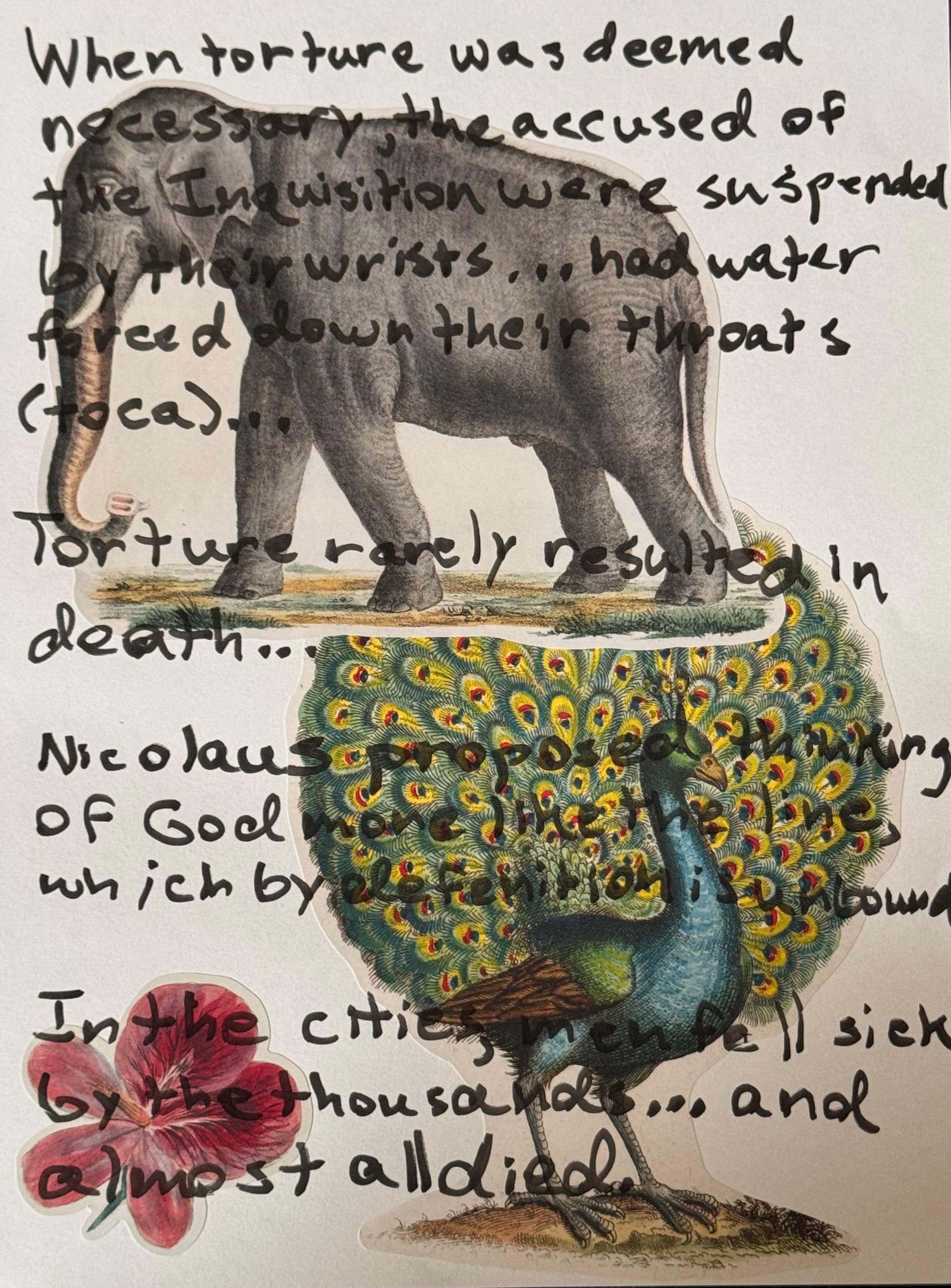
Torture was commonly used in criminal procedures in that era, and it was a method of the Inquisition, applied as a way of forcing confessions. The torturers, like the executioners, were agents of the Crown, not the Church. This distinction, which some cite to absolve the Church even today, was the ultimate fulfillment of the “two sword” theory promoted by Saint Bernard of Clairvaux three centuries before. When torture was deemed necessary, the accused of the Inquisition were suspended by their wrists with their bodies weighted (garrucha), had water forced down their throats (toca), were wrapped in ropes to be squeezed as they were tightened (potro). Careful records were kept of the proceedings. Here, again from Kamen, is the partial transcript of the interrogation of one woman accused, in 1568, of refusing to eat the flesh of pigs and of refusing to do housework on Saturdays: She was ordered to be placed on the potro. She said, “Senores, why will you not tell me what I have to say? Señor, put me on the ground—have I not said that I did it all?” She was told to tell it. She said, “I don’t remember—take me away—I did what the witnesses say.” She was told to tell in detail what the witnesses said. She said, “Señor, as I have told you, I do not know for certain. I have said that I did all that the witnesses say. Señores, release me, for I do not remember it.” . . . She was admonished to tell the truth and the garrotes were ordered to be tightened. She said, “Señor, do you not see how these people are killing me? I did it—for God’s sake, let me go.”35 Kamen judiciously points out that the inquisitors’ procedures, while no worse than those prevailing in other European tribunals, were in some ways less severe. Inquisitorial prisons could be relatively humane. Torture rarely resulted in death, or even permanent crippling. Confessions obtained under torture had to be reconfirmed by the suspect later, under “normal” conditions. For the most part, the many people put to death were found guilty of a clearly defined capital crime, heresy. Thus Jews as such were not officially targeted by the Inquisition, only those who had been baptized or were found to have encouraged the baptized to lapse into Judaism. This offense was so broadly defined, however—any Jewish “consorting” with a converso could be prosecuted—and so aggressively pursued that eventually the Inquisition did mount a frontal assault on Judaism itself. The Inquisition survived as an operating institution for three hundred years, and its methods varied widely during that long stretch of time. In its early years, when the as yet unnamed panic of the coming social and religious catastrophe we remember as the Reformation was the underlying driving force, thousands of unrepentant or relapsed heretics were burned at the stake. “Nothing, certainly,” Kamen says, “can efface the horror of the first twenty holocaust years. He comments elsewhere, “The savagery of the onslaught against the conversos was without equal in the history of any tribunal in the western world. Statistics kept by contemporary observers suggest that in the first eight years alone, two thousand were burned at the stake. Thousands of others would follow in the next two decades. The vast majority of those put to death by the Spanish Inquisition during its entire three hundred years perished in that first savage paroxysm, which is why the name Torquemada lives in infamy. Always in this story there is the cross. To a Jew, the cross’s proximity, if not centrality, to each new round of violence is only a reminder of its negative meaning. To a Christian, it still must come as a shock and a source of sorrow, as if the cross had not already been fraught enough by what the Romans did with it. The cross, as we saw, featured as a sacramental object at the beginning of the inquisitorial procedures, the friar holding up the crucifix for the swearing of the informant’s oath. At the other end of the process, in the climactic auto-da-fé, the cross featured as well. Repentant heretics were reconciled to the Church by being signed with the cross on the forehead, as the friar intoned, “Receive the sign of the cross, which you denied and lost through being deceived.” The way this story keeps coming back, at its most violent moments, to the sacred symbol of the cross reminds us that religious politics are always reflected in the religious imagination. When the Renaissance in visual art came to Spain in the next century, its glories would be transformed by an almost sadistic concentration on physical torment, derived from the friar-driven cult of such torment as a source of salvation. There would never be any mistaking the aesthetic of Italy for that of Spain. The cross accomplished the sanctification of the Iberian spirit of repression.
--Constantine's Sword - James Carroll
Nicolaus was a man of genius, not only an inventive philosopher and theologian but a mathematician whose speculations anticipated Copernicus (1473–1543). The free play of this man’s spacious mind led him to apply the insights of one discipline to another. He titled one essay, for example, “The Theological Complement Represented in the Mathematical Complements.” By means of such “complements,” he developed from mathematics a feel for what the Catholic theologian David Tracy calls “the logic of the infinite.” Tracy describes Nicolaus of Cusa as “the most balanced of the great Renaissance thinkers.” Instead of thinking of God in constrained images equivalent to mathematical symbols of the sphere or circle or triangle, Nicolaus proposed thinking of God in an image more like the line, which is by definition unbounded, impossible to hem in or to possess. The discursive reasoning of the scholastics, who slavishly imitated the method of Thomas Aquinas without preserving his spirit, seemed the opposite of such logic of the infinite to Nicolaus, and he criticized the prevailing theology of his day, in effect, for doing too much with too little. Nowhere was that theology better expressed than in the anathemas issued by the Council of Florence, just referred to. Theologians spoke of God as if they understood God fully, and they sought to enforce a uniformity of thought that left no room for mystery, ambiguity, or paradox. Nicolaus of Cusa saw, on the contrary, that God is God precisely in escaping and transcending total comprehension by human beings. Just as a line is defined by its movement in two opposite directions at once, so God is “the coincidence of opposites,” the one in whom maximum and minimum fall together. In God, this coincidence occurs in such a way that the contraries maintain their differences, which, mathematically speaking, is why God is more like a line than a point. Nicolaus of Cusa’s masterwork was called On Learned Ignorance, and his approach to God is characterized as apophatic, which means to posit by negating (an apophasis: “I will not bring up my opponent’s questionable financial dealings”). Nicolaus argued not that God is unknowable, but that God’s unknowability is the most profound and illuminating thing humans can know about God. This idea is the theological equivalent of the Copernican insight into the cosmos—that the earth revolves around the sun, not vice versa—that would come a generation later. Both ideas mean, as Tracy put it, that the old cosmology is finished, the closed system is collapsed, replaced by an open, infinite system.
--Constantine's Sword - James Carroll
The Church, too, had a problem, which grew more grievous as the decades passed. Having coerced Jews to convert in large numbers, Christians began to suspect that the conversions must have been insincere, since they were coerced. The irony was doubled and redoubled. Judaizing, the mingling of Christian and Jewish elements of faith, cult, and calendar, was defined as a heresy. The Church now began to move against it in earnest. But that meant investigating the conversos as a class, which implied that anyone with “Jewish blood,” whatever his or her religious identity had become, was suspect. “In fact,” the historian Angus MacKay writes, “the hatred of the conversos and their success grew into racial hatred. As early as 1449, the idea was being propagated that the pure blood of the Castilian Old Christians was being defiled by that of the Jewish race.” Ordinarily, such an idea would have been roundly rejected by all levels of official Catholicism. The Church had consistently emphasized the religious distinction between Judaism and Christianity, ignoring any racial distinction between Jews and Christians. But this was not an ordinary stretch of history. The division between those prepared to follow the logic of radical conversionism to its once unthinkable conclusion and those who maintained an attitude of restraint, even protection, toward Jews cut across the whole Church, including the papacy itself. Beginning about the time of the 1391 pogroms and the consequent forced conversions of large numbers of Jews, a succession of popes taking opposite sides of the question came to power, almost, as it were, alternating between sympathizers with Jews and sympathizers with the anti-Jewish friars. In effect, for the next century and a half, the Church, and the papacy, would be arguing with itself over what to do with the Jews.
--Constantine's Sword - James Carroll
THAT SO MANY “did flock” to baptismal fonts is a marker for Jews as much as for Christians. Martyrdom or apostasy? The answer had been given its ultimate expression in the story of the seven brothers and their mother in 2 Maccabees, written a hundred years before Christ. “There were also seven brothers who were arrested with their mother. The king tried to force them to taste pig’s flesh, which the Law forbids, by torturing them with whips and scourges. One of them, acting as spokesman for the others, said, ‘What are you trying to find out from us? We are prepared to die rather than break the laws of our ancestors.’ The king, in a fury, ordered pans and cauldrons to be heated over a fire.” With the siblings and mother watching, the first brother’s torture culminated in his being fried alive. After him, the other brothers, one at a time, were brought forward. “Never!” each one replied to the demand to eat, and each was then subjected to being scalped, his tongue removed, his limbs amputated, his being burned—all while the mother watched. To each one she said, “The Lord God is watching.” When her last son refused to eat pig’s flesh, the king implored the mother “to advise the youth to save his life.” She leaned close to her son and whispered, “I implore you, my child, observe heaven and earth, consider all that is in them, and acknowledge that God made them out of what did not exist, and that mankind comes into being in the same way. Do not fear this executioner, but prove yourself worthy of your brothers, and make death welcome, so that in the day of mercy I may receive you back in your brothers’ company.” The boy did so, with a defiant “What are you waiting for? I will not comply with the king’s ordinance. I obey the ordinance of the Law given to our ancestors through Moses.” The mother watched as this, her youngest son, treated “more cruelly than the others . . . met his end undefiled and with perfect trust in the Lord.” This seventh chapter of 2 Maccabees is perhaps the most violent passage in the Hebrew Scriptures, yet it ends with the most poignantly understated line in all the Scriptures, too: “The mother was the last to die, after her sons.”1 With such a story anchoring the collective memory of Jews, it was no departure from tradition, however much it shocked Christians, when, as a Jewish chronicler of the First Crusade reported, “The women girded their loins . . . and slew their own sons and daughters, and then themselves.” Martyrdom, even self-immolation, was an affirmation of faith—Kiddush Hashem—a way as Marc Cohen puts it, “of reenacting on a human plane the sacrificial cult of the ancient Jerusalem Temple.”
--Constantine's Sword - James Carroll
“In the cities, men fell sick by thousands, and lacking care and aid, almost all died.” This is Boccaccio writing of the Black Plague. “In the morning, their bodies were found at the doors of the houses where they had expired during the night.” Boccaccio was in Florence, and he says that “in the course of four or five months, more than one hundred thousand persons perished, a number greater than that estimated to be its population before this dreadful malady.”20 Between 1348 and 1351, something like twenty to twenty-five million people died as the disease spread through Europe from the southeast.21 The infection was caused by a bacillus that lived in the blood of rats, and that seems to have arrived in Europe on a merchant ship at Messina, in Sicily. By the time the plague had moved across the continent and into England, one in three of those living in Europe was dead. The bodies of victims were often left where they were, and many corpses were buried in large communal graves.22 This catastrophe, understandably, set off a vast panic, and given what had gone before, it is not surprising that the mass of Christians were ready to blame the Jews. Everyone was asking what had caused this disaster. Pope Clement VI (1342–1352), was stunned when, in 1348, eleven thousand people died in his own court city of Avignon, including seven cardinals.23 He was a Frenchman who had earned a doctorate at the University of Paris, and he summoned his learned advisors. When told that the cause of the plague was some conjunction of planets and stars, he scoffed. Clement ordered the papal physicians to dissect the corpses of plague victims, “in order that the origins of this disease might be known”24—an act that can be seen as the beginning of modern medicine. But survivors in the cities thought they knew the cause: a well-poisoning conspiracy of Jews. There was a heartbreaking poignancy in the widespread belief that the conspiracy had begun in Toledo, the one-time home of convivencia and center of the culture-creating tradition of Iberian translation. It was as if the intellectual transformation of Europe that had been spawned a century before in Toledo, largely, although not exclusively, by Jews, had been inverted by an act of black magic. The fruitful seeding of Christendom’s intellect was now perverted into the deadly pollution of its drinking water. A masterly rumor identified a native of Toledo, one Jacob Pascal, whose name suggested Passover, as the initiator of the plot. A cabal (a word we have from “Kabbalah”) of Iberian Jews was the supplier of poison to Jewish agents elsewhere in Europe—a first international conspiracy. Jews in Geneva, under torture, confessed that the rumor was true, which was all it took. As had been the case during the Crusades, the first major conflagration of anti-Jewish violence took place in the Rhineland, where Jews were slaughtered in large numbers. One chronicler reported that twelve thousand were put to death in Mainz—an echo of 1096. There was an echo, too, in the resistance the Jews of Mainz put up, and in their self-immolation when all was lost. “By the time the plague had passed,” Barbara Tuchman observed, “few Jews were left in Germany or the Low Countries. Officials of plague-stricken towns and cities wrote to officials elsewhere, warning of Jewish well poisoners. A contemporary chronicler wrote, “In the matter of this plague the Jews throughout the world were reviled and accused in all lands of having caused it through the poison which they are said to have put into the water and the wells—that is what they were accused of—and for this reason the Jews were burnt all the way from the Mediterranean into Germany, but not in Avignon, for the pope protected them there. Clement VI was the fourth pope to live at Avignon. He had presided over a lavish court, noted for its splendors. But, as indicated by his rejection of astrological superstition, the catastrophe of the plague brought out something great in him. His story is yet another of those all too rare chapels of heart in this grim history. He ordered the papal curia to maintain its routine as a way of defusing panic in the city, and he gave away a fortune to help those who had been struck down. Most important, and most dangerous to himself, he quelled the anti-Jewish riots in Avignon. He denounced violence against Jews, displaying courage, but also logic. In a papal bull, he pointed out the obvious fact that the supposed instigators of the plague were dying like everyone else. “That the Jews have provided the occasion or the cause for such a crime,” he declared, “has no plausibility.” Clement ordered bishops everywhere to instruct the people not to attack Jews, but unfortunately the provinces under the pope’s direct control seem to have been the only places where Jews were not assaulted in large numbers.31 As always, a Jew could escape the torment by accepting baptism, but again, it seems that relatively few did so. As in 1096, the chroniclers report that some Jewish communities—for example, those in Worms and Oppenheim—preempted their tormentors by committing mass suicide. “In some cities the Jews themselves,” a chronicler noted, “set fire to their houses and cremated themselves. The plague was an accelerating moment in the downward spiral of Jewish-Christian conflict, one to match the First Crusade, which had set the gyre winding. After 1348, anti-Jewish stereotyping became more vicious, with the Christian mind fixed on the Jew not merely as an enemy, as before, but also as a mortal threat. After the plague, Christians were more obsessed with death than ever, and a heightened fixation on the agonized death of Jesus, as always, brought with it a renewed scapegoating of the “deicide” Jews. Popes, bishops, and some princes, following Clement VI’s lead, would continue to defend Jews from violence and forced conversion, but they would also intensify their sponsorship of the program of proselytizing, which itself became more coercive after the plague. The inability of ecclesiastical and political leaders even now to grasp, as Rosemary Radford Ruether put it, “that the mob merely acted out, in practice, a hatred which the Church taught in theory and enforced in social degradation whenever possible”34 was never more tragic or dangerous.
--Constantine's Sword - James Carroll
Undertaking emerged as a profession, though the job entailed little more than selling funeral props and decorations. The local undertaker might build you a coffin, rent you a hearse or funeral carriage, or sell you mourning clothes or jewelry. They often took other jobs to supplement their income, leading to some amusing nineteenth-century ads: “John Jensen: Undertaker, Tooth Puller, Lamp Lighter, Frame Builder, Blacksmith, Cabinetmaker.” Then came the American Civil War, the deadliest war in United States history. The Battle of Antietam on September 17, 1862, holds the dubious honor of having been the Civil War’s (and American history’s) single bloodiest day, during which 23,000 men died on the battlefield, their maggot-ridden corpses bloated amidst the equally bloated bodies of horses and mules. When the 137th Pennsylvania Regiment arrived four days later, its leader requested that his men be allowed to consume liquor as they buried the bodies, there being only one state in which it was possible to do the job: drunk. During the four years of battles between the North and South, many of the soldiers’ families had no way to retrieve their dead sons and husbands from the battlefields. The corpses could be transported on trains, but after a few days in the Southern summer heat, the dead entered the deepest throes of decomposition. The smell emanating from a body left in the sun would have been far worse than a mere olfactory inconvenience. According to the account of a doctor for the Union army, “during the battle of Vicksburg the two sides called for a brief armistice because of the stench of corpses disintegrating in the hot sun.” Transporting bodies hundreds of miles in this odious condition was a nightmare for train conductors, even the most patriotic among them. Railroads began refusing to transport bodies not sealed in expensive iron coffins—not a viable option for most families. The situation brought out the entrepreneurial impulses of men, who, if a family could pay, would perform a new preservative procedure called embalming—right there on the battlefield. They followed the skirmishes and battles looking for work, America’s first ambulance chasers. Competition was fierce, with stories of embalmers burning down one another’s tents and placing advertisements in local papers reading, “Bodies Embalmed by Us NEVER TURN BLACK.” To market the effectiveness of their services, the embalmers would display real preserved bodies they had plucked from the unknown dead, propping the corpses up on their feet outside the tents to better demonstrate their talents. The embalming tents on the battlefield often contained only a simple plank of wood atop two barrels. The embalmers injected chemicals into the arterial systems of the newly dead, their own special blends of “arsenicals, zinc chloride, bichloride of mercury, salts of alumina, sugar of lead, and a host of salts, alkalies, and acids.” Dr. Thomas Holmes, still regarded by many in the funeral industry as the patron saint of embalming, maintained that during the Civil War he personally embalmed more than 4,000 dead soldiers in this fashion, at the cost of $100 a body. The discount option, for those not inclined toward the highbrow methods of chemicals and injections, might be to eviscerate the internal organs and fill the body cavity with sawdust. Defiling the body in this way was considered a sin in both the Protestant and Catholic traditions, but the desire to see the face of a loved one again sometimes trumped religious ideology. The full evisceration of the body cavity is not so different from what is done today, minus the sawdust. Perhaps the dirtiest secret about the process of modern embalming is the occult use of a skinny, lightsaber-sized piece of metal known as the trocar. Bruce raised his trocar like the sword Excalibur and pushed its pointed tip into Cliff’s stomach, stabbing him just below his belly button. He jabbed the trocar in, breaking the skin, and went to work puncturing Cliff’s intestines, bladder, lungs, and stomach. The trocar’s job in the embalming process is to suck out any fluids, gases, and waste in the body cavity. The brown liquid slid up the trocar’s tube with an uncomfortable gurgling and sucking noise before splashing down the drain of the sink and into the sewers. Then the trocar reversed directions, no longer sucking but dumping more salmon-pink cocktail, of an even stronger chemical concentration this time, into the chest cavity and abdomen. If there had been any doubt Cliff was dead, the trocar dispelled it.
--Smoke Gets in Your Eyes - Caitlin Doughty
Death in America began as an entirely homegrown operation. A person would die in their own bed, surrounded by their family and friends. The corpse would be washed and shrouded by the man or woman’s closest living relations and laid out for several days in the home for a wake—a ritual named for the Old English word for “keeping watch,” not, as it is often believed, the fear that the corpse might suddenly wake up. To prevent decomposition while the body remained at home, innovations like vinegar-soaked cloths and tubs of ice beneath the corpse were developed in the nineteenth century. During the wake there was food to be consumed, alcohol to be imbibed, and a sense of releasing the dead person from their place in the community. As Gary Laderman, scholar of American death traditions, put it, “Although the body had lost the spark that animated it, deeply rooted social conventions demanded that it be given proper respect and care from the living.” During the wake, a wooden coffin was constructed either by the family or perhaps a local cabinetmaker. The hexagonal coffin was tapered at the bottom, indicating this was indeed a container for a dead human, unlike today’s rebrand of both the shape (a plain rectangle) and the name (casket). After several days had passed, the corpse was placed in the coffin and carried on the shoulders of family members to a nearby grave.
--Smoke Gets in Your Eyes - Caitlin Doughty
At the table where I lingered because I had the time, I looked around while my fingers rolled the bread into balls. The world was a place. Which suited me for living: in the world I could press one soft ball of bread into another, all I had to do was rub them together and, without too much exertion, just knead them enough to make one surface bind with another, and so with pleasure I was shaping a curious pyramid that satisfied me: a right triangle made of round shapes, a shape that is made of its opposite shapes. If that had any meaning for me, the bread and my fingers probably knew.
--The Passion According to G.H. - Clarice Lispector, Benjamin Moser, and Idra Novey
We can be confident that cannibalism is for the deranged and heartless because we are caught in what anthropologist Clifford Geertz called “webs of significance.” From the time we are born, we are indoctrinated by our specific culture as to the ways death is “done” and what constitutes “proper” and “respectable.” Our biases in this matter are inescapable. As much as we fancy ourselves open-minded, we are still imprisoned by our cultural beliefs. It is like trying to walk through a forest after the spiders have been up all night spinning webs between the trees. You may be able to see your destination in the distance, but if you attempt to walk toward that destination, the spiderwebs will catch you, sticking to your face and lodging themselves awkwardly in your mouth. These are the webs of significance that make it so hard for Westerners to understand the cannibalism of the Wari’. The Wari’ were mortuary cannibals, meaning their form of cannibalism was a ritual performed at the time of death. From the moment a member of the Wari’ took their last breath, their corpse was never left alone. The family rocked and cradled the body to the sound of a steady, high-pitched chant. This chanting and wailing announced the death to the rest of the community, and soon everyone joined in the hypnotic sound. Relatives from other villages rushed to get to the corpse’s side to participate in the ritual for the dead. To prepare for the consumption of the flesh, relatives walked through the village and pulled a wooden beam from every house, leaving the roofs sagging. Anthropologist Beth Conklin described this sagging as a visual reminder that death had violated the community. The wood gathered from the homes was bundled together, decorated with feathers, and used as kindling for a roasting rack. At last the family relinquished the corpse and the body was cut into pieces. The internal organs were wrapped in leaves and the flesh from the limbs placed directly on the rack to cook. The women of the village prepared corn bread, considered an ideal pairing for human meat. The act of cooking human flesh as if it were “no more than a piece of meat” did not trouble the Wari’. Animals and their flesh meant (and still mean) something very different to members of the Wari’ tribe than they do to us. To the Wari’, animals have dynamic spirits. Animals do not belong to, nor are they any lower than, human beings. Depending on the day, humans and animals alternate between hunter and hunted. Jaguars, monkeys, and tapirs might see themselves as humans and see humans as animals. Wari’ have respect for all the meat they consume, human or animal. The people who actually consumed the roasted flesh were not the dead person’s closest blood relatives, such as wives or children. That honor—and it was indeed an honor—went to chosen people who were like blood to the deceased: in-laws, extended relatives, and community members, known as affines. None of the affines were vengeful, flesh-hungry savages, desperate for the taste of grilled human, and neither were they after the protein the human flesh provided—both common motives ascribed to cannibals. In fact, the corpse, which had been laid out over several days in the warm, humid climate of the Amazon rain forest, was often well into various stages of decomposition. Eating the flesh would have been a smelly, foul experience. The affines often had to excuse themselves to vomit before returning to eat again. Yet they forced themselves to continue, so strong was their conviction that they were performing a compassionate act for both the family and the person who had died. The affines weren’t eating the dead to preserve life force or power; they ate to destroy. The Wari’ were horrified by the thought of a dead body being buried and left fully intact in the ground. Only cannibalism could provide the true fragmentation and destruction they desired. After the flesh was consumed, the bones were cremated. This total disappearance of the body was a great comfort to the family and community. The dead had to be removed to make the community whole again. The body destroyed, the dead person’s possessions, including the crops they had planted and the home they had built, were burned as well. With everything gone, the family of the dead person was at the mercy of their relatives and community to take care of them and help them rebuild. And the community did take care of them, reinforcing and strengthening their communal bonds. In the 1960s the Brazilian government forced the Wari’ to give up their rituals and begin burying their dead. Placing their dead in the ground to rot was the absolute opposite of what they had practiced and believed. As long as the physical body remained intact, it was a torturous reminder of what had been lost. If we had been born into the Wari’ tribe, the cannibalism we dismiss as barbarism would have been our own cherished custom, one we engaged in with sincerity and conviction. The burial practice in North America—embalming (long-term preservation of the corpse), followed by burial in a heavy sealed casket in the ground—is offensive and foreign to the Wari’. The “truth and dignity” of the Western style of burial is only the truth and dignity as determined by our immediate surroundings.
--Smoke Gets in Your Eyes - Caitlin Doughty
There is no mechanical loading device to deposit babies neatly into the chamber’s fiery arms, as there is for adults. You, the crematory operator, had to perfect the toss: the baby leaving your hand and coming to rest right below the main flame as it shot down from the ceiling of the retort. You had to make sure the baby landed in the sweet spot. With practice, you came to be very good at it. Baby cremations were done at the end of the workday. The bricks lining the chamber grew so hot by the end of the day that the tiny babies practically cremated themselves. It was not uncommon for Mike to ask me to forgo cremating another adult and “knock out a couple of babies” before the end of the day. Adults could take hours to cremate, including the cremation itself and the cool-down process. Babies cremated in twenty minutes, tops. I found myself setting goals: All right, Caitlin, it’s what? Three fifteen p.m.? I bet you can do five babies before five o’clock. C’mon, girl, five before five. You get after that goal! Appalling? Absolutely. But if I let myself be sucked into the sorrow surrounding each fetus—each wanted but wasted tiny life—I’d go crazy. I’d end up like the security guard from the hospital: humorless and afraid.
--Smoke Gets in Your Eyes - Caitlin Doughty
Per Mike’s instructions, my first stop was the nurses’ station. At this point, addressing the topic of death was still a struggle for me. My natural inclination when meeting new people is a warm smile and a little small talk, but when the goal is to collect baby corpses, any smile seems gauche and out of place. “How are you today? I’m here for the baby corpses. By the way, girl, your earrings are fabulous.” On the other hand, if you keep your head bowed and your hands crossed and glumly state your reason for being there, you become the creepy girl from the funeral home. A delicate balance is required: happy but not too happy. After the nurses conferred and decided I had the proper authority to abscond with the babies, I was escorted by security to the hospital morgue. The security guard was a stern woman who knew my dastardly purpose and would have none of it. After several botched attempts and small slams into the wall, I successfully wheeled my gurney into the elevator and we began our awkward descent to the morgue. The guard’s first question was reasonable: “Why do you have that gurney?” “Well,” I replied, “you know, um, for the babies—to get them out?” Her reply was quick: “The other guy brings a little cardboard box. Where’s the other guy?” A cardboard box. Bloody genius. A discreet, portable, and sensible multi-baby conveyance. Why had Mike not mentioned this? I had failed already. The security guard unlocked the morgue to let me in and stood there with her arms crossed, her distaste palpable. The rows of identical stainless-steel coolers gave me no inkling of where the babies might be hiding. As much as it pained me, I was forced to inquire where they were. “You don’t know?” came her response. She slowly raised a single finger, pointing to a cooler. She proceeded to watch as I removed the babies one by one and strapped them to the gurney in the most nonsensical way possible. I silently prayed my fairy deathmother would magically turn my gurney into a cardboard box or a milk crate or something so I wouldn’t have to roll these formaldehyde fetuses down the hall on a gurney made for a full-sized adult. I thought I was going to be able to slink away with my babies, head hung low but dignity intact. And then, she dealt the final blow: “Ma’am, you’re gonna need to sign for those.” Had I remembered to bring a pen? No, no I had not. Noticing several pens hanging from the guard’s shirt pocket, I asked, “Well, could I borrow your pen?” Then came the look—perhaps the most derisive, scornful look that has ever been directed at me. As if I had personally taken the lives of each one of these infants with zero regret. “Maybe when you take those gloves off,” she said, looking at my hand, still covered with baby-transferring rubber gloves. To be fair, I’m not sure I would want to hand over my pen (precious commodity in a bureaucracy like an American hospital) to a girl who had just been handling baby corpses. But the way she said it gave me palpable knowledge of this woman’s fear of death. It didn’t matter how many times I smiled at her, expressed my new-on-the-job status with bumbling Hugh Grant–esque apologies. This woman had decided that I was dirty and deviant. Handmaiden to the underworld. Her regular duties as a security guard didn’t faze her, but these trips to the morgue were too much. I removed the gloves, signed the release papers, and pushed the babies out to my van, a sad excuse for a final stroller ride.
--Smoke Gets in Your Eyes - Caitlin Doughty
A career in academia had occurred to me, but I had neither the intellect nor the stamina for it. It was a cold, harsh world outside the confines of the ivory tower, and all I had to show for my years of college was a fifty-page bachelor’s thesis titled: “In Our Image: The Suppression of Demonic Births in Late Medieval Witchcraft Theory.” My thesis—which at the time I considered to be my life’s great masterwork—centered on the late medieval witch trials. When I speak of witches, I don’t mean greeting-card Halloween witches with warts and black pointy hats. I mean women (and men) who were accused of sorcery in the late Middle Ages and then burnt at the stake. And those witches. The numbers are fuzzy, but lowball historical estimates have well over 50,000 people executed in western Europe for crimes of maleficium, the practice of harmful magic. And those 50,000 were just the people who were actually executed for witchcraft: burned, hanged, drowned, tortured, and so on. Countless more were accused of witchcraft and put on trial for their supposed crimes. These people—the majority of whom were women—were not accused of simple, entry-level sorcery like lucky rabbits’ feet or love potions. They were accused of nothing less than making a pact with Satan to spread death and destruction. Since Europe was largely illiterate, the only way an aspiring witch could seal a deal with the devil was through a sexual act—an erotic signature, of sorts. Beyond wantonly giving themselves to Satan at a black Mass, accused witches were thought to raise storms, kill crops, make men impotent, and take the lives of infants. Any uncontrollable event in medieval- and Reformation-era Europe might very well have been a witch’s doing. It is easy for someone in the twenty-first century to be dismissive and declare, “Dang, those medieval folk are so crazy with their flying demonic minions and sex pacts.” Yet witchcraft was as real to medieval men or women as the Earth being round or smoking causing cancer is real to us. It didn’t matter whether they lived in a city or a small village, whether they were a lowly peasant farmer or the pope himself. They knew that there were witches and the witches were killing babies and crops and having lewd sex with the devil. One of the best-known books of the 1500s was a witch-hunting manual by an inquisitor named Heinrich Kramer. The Malleus Maleficarum, or Hammer of the Witches, was the go-to guide for finding and getting rid of witches in your town. It is in this book that we learn, supposedly from a firsthand account of a witch in Switzerland, what witches did with the newborn infants: This is the manner of it. We set our snares chiefly for unbaptized infants . . . and with our spells we kill them in their cradles or even when they are sleeping by their parents’ side, in such a way that afterwards [they] are thought to have been overlain or to have died some other natural death. Then we secretly take them from their graves, and cook them in a cauldron, until the whole flesh comes away from the bones to make a soup which may easily be drunk. Of the more solid matter we make an unguent which is of virtue to help us in our arts and pleasures and in transportation.
--Smoke Gets in Your Eyes - Caitlin Doughty
I looked at the room with distrust. So there was a roach. Or roaches. Where? behind the suitcases perhaps. One? two? how many? Behind the motionless silence of the suitcases, perhaps a whole darkness of roaches. Each immobilized atop another? Layers of roaches — which all of a sudden reminded me what I’d discovered as a child when I lifted the mattress I slept on: the blackness of hundreds and hundreds of bedbugs, crowded together one atop the other. The memory of my childhood poverty, with bedbugs, leaky roofs, cockroaches and rats, was like that of my prehistoric past, I had already lived with the first creatures of the Earth. One cockroach? many? how many?! I asked myself in a rage. I let my gaze wander over the naked room. No sound, no sign: but how many? No sound and yet I distinctly felt an emphatic resonance, which was that of silence chafing against silence. Hostility overwhelmed me. It’s more than just not liking roaches: I don’t want them.
--The Passion According to G.H. - Clarice Lispector, Benjamin Moser, and Idra Novey
Then, before understanding, my heart went gray as hair goes gray. Meeting the face I had put inside the opening, right near my eyes, in the half-darkness, the fat cockroach had moved. My cry was so muffled that only the contrasting silence let me know I hadn’t screamed. The scream had stayed beating in my chest. Nothing, it was nothing — I immediately tried to calm down from my fright. I’d never expected in a house meticulously disinfected against my disgust for cockroaches that this room had escaped. No, it was nothing. It was a cockroach that was slowly moving toward the gap. From its bulk and slowness, it had to be a very old cockroach. With my archaic horror of cockroaches I’d learned to guess, even from a distance, their ages and dangers; even without ever having really looked a cockroach in the face I knew the ways they existed. It was just that discovering sudden life in the nakedness of the room had startled me as if I’d discovered that the dead room was in fact mighty. Everything there had dried up — but a cockroach remained. A cockroach so old that it was immemorial. What I had always found repulsive in roaches is that they were obsolete yet still here. Knowing that they were already on the Earth, and the same as they are today, even before the first dinosaurs appeared, knowing the first man already found them proliferated and crawling alive, knowing that they had witnessed the formation of the great deposits of oil and coal in the world, and there they were during the great advance and then during the great retreat of the glaciers — the peaceful resistance. I knew that roaches could endure for more than a month without food or water. And that they could even make a usable nutritive substance from wood. And that, even after being crushed, they slowly decompressed and kept on walking. Even when frozen, they kept on marching once thawed. . . . For three hundred and fifty million years they had been replicating themselves without being transformed. When the world was nearly naked, they were already sluggishly covering it. Like there, in the naked and parched room, the virulent drop: in the clean test-tube a drop of matter.
--The Passion According to G.H. - Clarice Lispector, Benjamin Moser, and Idra Novey
And it was on one of the walls that flinching with surprise I saw the unexpected mural. On the whitewashed wall, beside the door — and that’s why I hadn’t seen it — were nearly life-sized charcoal outlines of a naked man, a naked woman, and a dog that was more naked than a dog. Upon the bodies nothing was drawn of what nakedness reveals, the nakedness simply came from the absence of everything that covers it: they were the outlines of an empty nakedness. The lines were coarse, made with a broken-tipped piece of charcoal. Some strokes were doubled as if one line were the trembling of the other. A dry trembling of dry charcoal. The rigidity of the lines pegged the blown-up and doltish figures on the wall, like three automatons. Even the dog had the mild madness of something that doesn’t move by its own strength. The coarseness of the excessively firm line made the dog something solid and petrified, more pegged to itself than to the wall.
--The Passion According to G.H. - Clarice Lispector, Benjamin Moser, and Idra Novey
My friends in San Francisco at this time, we all call each other “girl,” except for the ones who think they are too butch for such nellying, though we call them “girl” maybe most of all. My women friends call each other “girl” too, and they say it sometimes like they are a little surprised at how much they like it. This, for me, began in meetings for ACT UP and Queer Nation, a little word that moved in on us all back then. When we say it, the word is like a stone we pass one to the other: the stone thrown at all of us. And the more we catch it and pass it, it seems the less it can hurt us, the more we know who our new family is now. Who knows us, and who doesn’t. It is something like a bullet turned into something like a badge of pride.
--How to Write an Autobiographical Novel - Alexander Chee
I AM HALF WHITE, half Korean, or, to be more specific, Scotch-Irish, Irish, Welsh, Korean, Chinese, Mongolian. It has been a regular topic all my life, this question of what I am. People will even tell me, like my first San Francisco hairdresser. “Girl, you are mixed, aren’t you? But you can pass,” he said, as if this was a good thing. He said this as he scrutinized me in the mirror, looking at me as if I had come in wearing a disguise. “Pass as what?” I asked. “White. You look white.” When people use the word “passing” in talking about race, they only ever mean one thing, but I still make them say it. He told me he was Filipino. “You could be one of us,” he said. “But you’re not.” Yes. I could be, but I am not. I am used to this feeling. As a child in Korea, living in my grandfather’s house, I was not to play in the street by myself: Amerasian children had no rights there generally, as they usually didn’t know who their father was, and they could be bought and sold as domestic help or as prostitutes, or both. No one would check to see if I was any different from the others. “One day everyone will look like you,” people say to me all the time. I am a citizen of a nation that has only ever existed in the future, a nation where nationalism dies of confusion. I cringe whenever someone tells me I am a “fine mix,” that it “worked well.” What if it hadn’t? After I read Eduardo Galeano’s stories in Memory of Fire, I mostly remember the mulatto ex-slaves in Haiti, obliterated when the French recaptured the island, the mestiza Argentinean courtesans—hated both by the white women for daring to put on wigs as fine as theirs, and by the Chilote slaves, who think the courtesans put on airs when they do so. Galeano’s trilogy is supposed to be a lyric history of the Americas, but it read more like a history of racial mixing. I found in it a pattern for the history of half-breeds hidden in every culture: historically, we are allowed neither the privileges of the ruling class nor the community of those who are ruled. To each side that disowns us, we represent everything the other does not have. We survive only if we are valued, and we are valued only for strength, or beauty, sometimes for intelligence or cunning. As I read those stories of who survives and who does not, I know that I have survived in all of these ways and that these are the only ways I have survived so far. This beauty I find when I put on drag, then: it is made up of these talismans of power, a balancing act of the self-hatreds of at least two cultures, an act I’ve engaged in my whole life, here on the fulcrum I make of my face. That night, I find I want this beauty to last because it seems more powerful than any beauty I’ve had before. Being pretty like this is stronger than any drug I’ve ever tried. But in my blond hair, I ask myself: Are you really passing? Or is it just the dark, the night, people seeing what they want to see? And what exactly are you passing as? And is that what we are really doing here? Each time I pass that night, it is a victory over these doubts, a hit off the pipe. This hair is all mermaid’s gold, and like anyone in a fairy tale I want it to be real when I wake up.
--How to Write an Autobiographical Novel - Alexander Chee
John knocks on the door. “Girl!” he says through the door. “Aren’t you ready yet?” He is already finished, dressed in a sweater and black miniskirt, his black banged wig tied up with a pink bow. He has highlighted his cheekbones with rouge, which I forgo. He is wearing high heels; I have on combat boots. I decided to wear sensible shoes, but John wears fuck-me pumps, the heels three inches high. This is my first time. It is Halloween tonight in the Castro and we are both trying to pass, to be “real,” only we are imitating very different women. What kind of girl am I? With the wig in place, I understand that it is possible I am not just in drag as a girl, but as a white girl. Or as someone trying to pass as a white girl. “Come in!” I yell back. John appears over my shoulder in the mirror, a cheerleader gone wrong, the girl who sits on the back of the rebel’s motorcycle. His brows rise all the way up. “Jesus Mother of God,” he says. “Girl, you’re beautiful. I don’t believe it.” “Believe it,” I say, looking into his eyes. I tilt my head back and carefully toss my hair over my right shoulder in the way I have seen my younger sister do. I realize I know one more thing about her than I did before—what it feels like to do this and why you would. It’s like your own little thunderclap. “Scared of you,” John says. “You’re flawless.” “So are you,” I say. “Where’s Fred?” Fred is my newest boyfriend, and I have been unsure if I should do this with him, but here we are. “Are you okay?” Fred asks, as if something has gone wrong in the bathroom. “Oh, my God, you are beautiful.” He steps into the doorway, dazed. He still looks like himself, a skinny white boy with big ears and long eyelashes, his dark hair all of an inch long. He hasn’t gotten dressed yet. He is really spellbound, though, in a way he hasn’t been before this. I have never had this effect on a man, never transfixed him so thoroughly, and I wonder what I might be able to make him do now that I could not before. “Honey,” he says, his voice full of wonder. He walks closer, slowly, his head hung, looking up at me. I feel my smile rise from somewhere old in me, maybe older than me; I know this scene, I have seen this scene a thousand times and never thought I would be in it. This is the scene where the beautiful girl receives her man’s adoration, and I am that girl. In this moment, the confusion of my whole life has receded. No one will ask me if I am white or Asian. No one will ask me if I am a man or a woman. No one will ask me why I love men. For a moment, I want Fred to stay a man all night. There is nothing brave in this: any man and woman can walk together, in love and unharassed in this country, in this world—and for a moment, I just want to be his overly made-up girlfriend all night. I want him to be my quiet, strong man. I want to hold his hand all night and have it be only that; not political, not dangerous, just that. I want the ancient reassurances legislated for by centuries by mobs. He puts his arms around me and I tip my head back. “Wow,” he says. “Even up close.” “Ever kissed a girl?” I ask. “No,” he says, and laughs. “Now’s your chance,” I say, and he leans in, kissing me slowly through his smile.
--How to Write an Autobiographical Novel - Alexander Chee
If I’ve done my job, she said in the last class, you won’t be happy with anything you write for the next ten years. It’s not because you won’t be writing well, but because I’ve raised your standards for yourself. Don’t compare yourselves to each other. Compare yourselves to Colette, or Henry James, or Edith Wharton. Compare yourselves to the classics. Shoot there. She paused. This was another of her fugue states. And then she smiled. We all knew she was right. Go up to the place in the bookstore where your books will go, she said. Walk right up and find your place on the shelf. Put your finger there, and then go every time. In class, the idea seemed ridiculous. But at some point after the class ended, I did it. I walked up to the shelf. Chabon, Cheever. I put my finger between them and made a space. Soon, I did it every time I went to a bookstore. Years later, I tell my own students to do it. As Thoreau, someone Annie admired very much, once wrote, “In the long run, we only ever hit what we aim at.” She was pointing us there.
--How to Write an Autobiographical Novel - Alexander Chee
For all that I wanted to be extraordinary, I was no different from those I read for. I was sending my first novel out to publishers, and wanted to know if it would be sold. I was dating a man I felt seriously about for the first time in five years, and became obsessed with knowing how the relationship would turn out. Was I really going to sell the novel? Was the man really over his ex-boyfriend? Where was he the other night when he didn’t want to come over? I might take the cards out to be reassured, but midnight, when you suspect your boyfriend of cheating, or of still being in love with his ex, is, shall we say, a bad time to draw the cards. I acted badly, I suspect, because of the cards, becoming more jealous or apprehensive than I might have if I’d only seen things as they were, if I’d only stayed within the bounds of what we experience of the world. I’d have false ideas by the time I spoke with the man again, ideas that had nothing to do with what was happening. My interest, I can see now, was in whether I could know the answers without asking questions regarding my own insecurities. Instead of conducting some basic relationship emotional hygiene—Is this working for you? Is this working for me?—I went to the cards and returned with a mind full of fictions. If I had good news from the cards, it made me lazy; bad news, and I couldn’t sleep. And this, of course, is why you should never read for yourself. You can’t give yourself the impersonal reading you need. It’s much like writing an essay or including autobiographical content in fiction—to succeed, it requires an ability to be coldly impersonal about yourself and your state, so as not to cloud what is there with what you want to see. I think few of us know enough about our lives to know our place in them—we can’t see ourselves as we might a character in a novel, with the same level of detachment and appraisal. We can’t, in other words, see ourselves as I wanted to that day when I entered the store and bought my cards. We think this means this, and that means that, and in the meantime the true meaning is somewhere else, and the omen lies on the ground, face-down, as good as mute. And the reader is sitting there looking at the cards in front of him, trying to read for himself as his life moves on in ways he can’t see. If I could, I’d go back in time and tell myself: This is how it turns out. You, sitting here, paralyzed by fear, alone in your apartment, reading cards.
--How to Write an Autobiographical Novel - Alexander Chee


