Inhabited space transcends geometrical space
If you are counting your enemies, you should not count me among them, sir
q1 — confinement and catharsis
illidan’s trapped immortality, chee’s use of tense as self-hypnosis, bachelard’s houses bracing against hurricanes — they all suggest that pressure creates revelation. do you think catharsis only happens when something — or someone — can’t move anymore?
## Transcript
Here, I see catharsis being used as a term of release from a problem, and "can't move anymore" suggests confinement, right?


Illidan is trapped in jail. Chee is trapping his usage of word choice, and houses are bracing themselves against hurricanes by being bolted to the ground, standing their ground.
[1 minute]
I think that freedom of choice is important. I'm a big proponent of agency.
 Contributors to Wikimedia projects
I really like the idea of people being able to take a number of options and pursue what brings them joy. The pursuit of happiness is something that appeals to me as a construct, even above happiness itself in a weird way. Any true fan of *Hunter x Hunter* knows that life is about the detours.

It's about understanding that what happens along the road can be more important than what you're hunting for. That being said, I think that the constraint of a goal is really necessary in order to have that driving motivation.
[2 minutes]
To live as a goalless creature, to be completely captivated by the constraints of the present—or maybe the freedom of the present—and all of the things that the present could represent is a different type of hell, perhaps.
People who live like flies, for a single day — would that at last be infuriating enough?
The Book Against Death - Elias Canetti, Joshua Cohen, and Peter Filkins
Hell is an extreme term here, of course, but I mean that I don't think it allows you to have that catharsis, that sense of release. I think that sense of release comes from working really hard towards something that means something to you and then achieving something, either that thing itself or a lesson that is equivalently valuable to that thing.
In order to get that, it's the lessons you learn through the effort you apply through the constraints. The constraints here involve making choices that actively limit yourself in favor of a goal. So, I think again, here's that kind of balance: it's the agency to choose what your goal is and the constraint of always having a goal, perhaps.
Define the cost of success and be ready to pay it. Because nothing worthwhile is free. And remember that most financial costs don’t have visible price tags. Uncertainty, doubt, and regret are common costs in the finance world. They’re often worth paying. But you have to view them as fees (a price worth paying to get something nice in exchange) rather than fines (a penalty you should avoid).
The Psychology of Money - Morgan Housel
q2 — scale and story
chee calls the novel “a thought so long it can’t be perceived all at once.” that sounds like the same feeling as standing under a suspension bridge or inside a storm-beaten house. how do you personally navigate that scale when you’re building a story or a life — something too big to see at once?
q3 — faith and material
and then kingsolver drops us in the congo — religion, exploitation, diamonds, manure for roses. what do you make of this rhythm, that everything beautiful — bridges, flowers, art — seems to come from something messy, even violent?
closing:
so maybe the common thread between bridges and books, demons and diaries, is this: everything worth making asks you to stand in the tension between collapse and completion. what do you think holds you up in that space?
## Transcript
I had to think about this. Collapse and completion.

I think completion is perhaps, in song terminology, the feeling of completing a lyric, like in the end, it doesn't even matter—if you're a Linkin Park fan. That kind of drive towards completion is a drive towards feeling satiated.
Collapse is kind of the opposite. Collapse is the desire for something to be broken at an incredibly deep level, the desire for randomness and pure recreation.
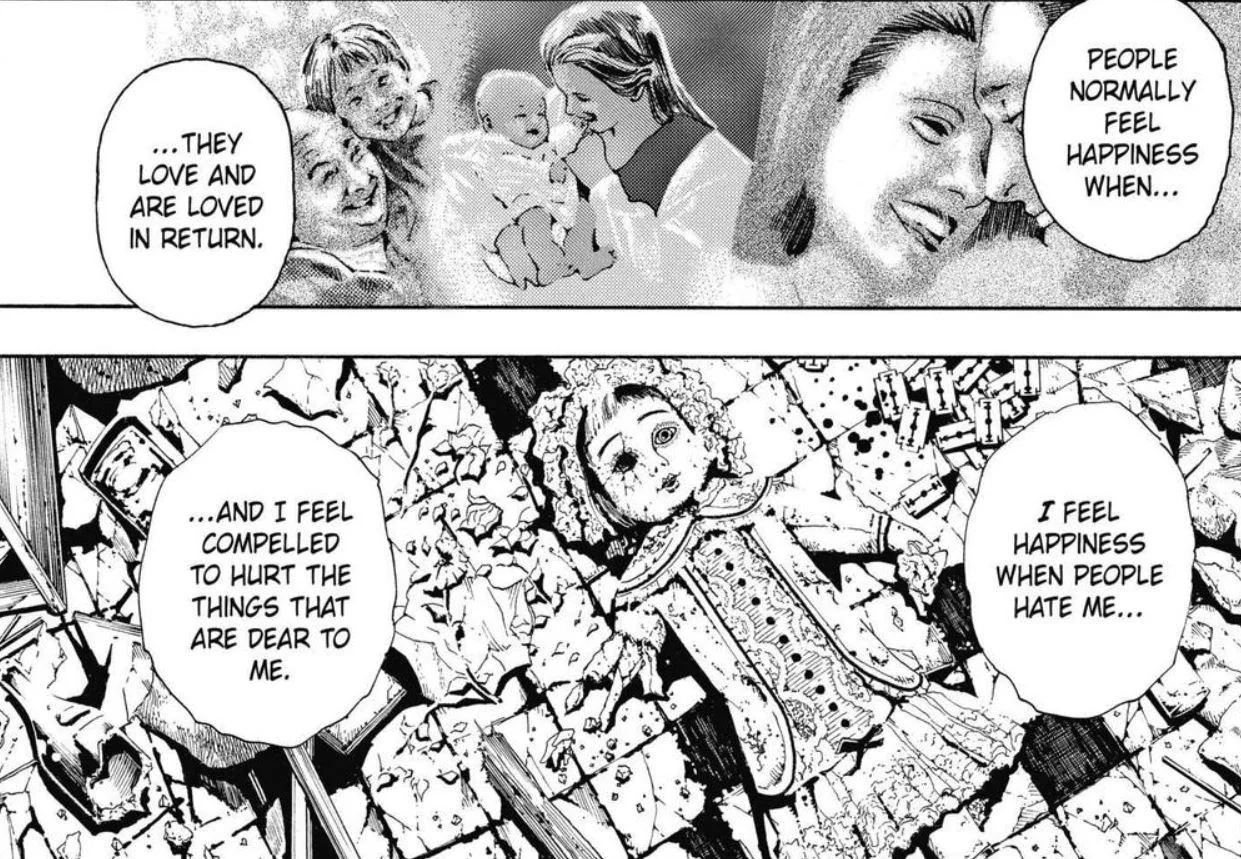
There is a space for that from time to time.
[1 minute]
I think dissonance is, again, in the musical sense, the ability to create by being thrown into new, violent elements.
A good example of this is Brian Eno's creative strategies, or his card game, Oblique Strategies.
 Contributors to Wikimedia projects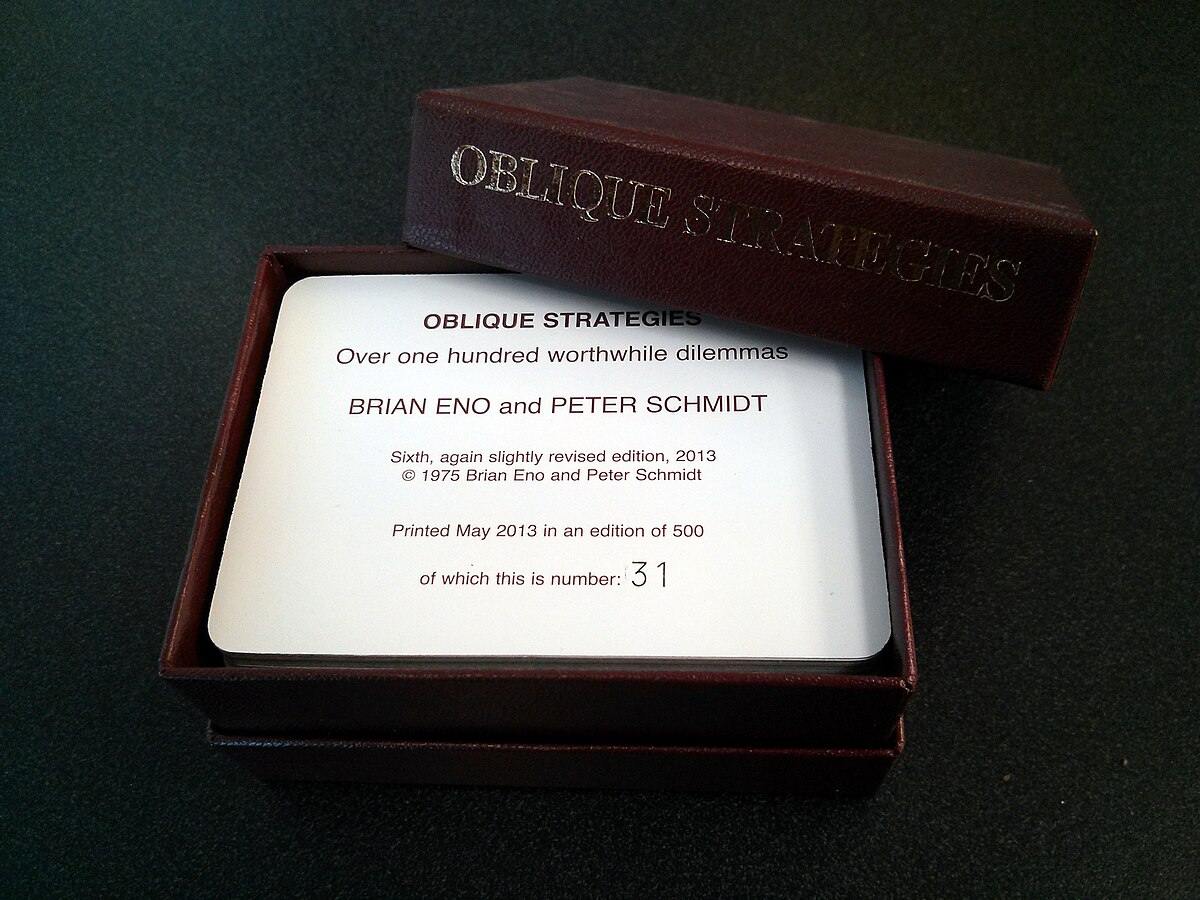
Personally, when it comes to collapse in my world, collapse looks like the ability to let go of particular notions that I have of myself or the world. Sometimes those notions are pretty hard. Specifically, these notions exist about what I envision for myself as a future being and the successes that I've had for myself.
Whatever people do, feel, think, or say, don’t take it personally. If they tell you how wonderful you are, they are not saying that because of you. You know you are wonderful. It is not necessary to believe other people who tell you that you are wonderful. Don’t take anything personally. Even if someone got a gun and shot you in the head, it was nothing personal. Even at that extreme.
The Four Agreements - Don Miguel Ruiz, Janet Mills
One thing that is a good example of this in the local space of posting on the Internet is: is there value in posting on a blog that very few people read?
The process of audience building, she told me, because it means developing relationships, has to be “organic and ongoing.” You can’t start frantically tweeting and blogging when your book comes out, as many authors do, she said; by then it’s too late. Hence the popularity of the “one-a” genre (one-a-day, one-a-week), like Hische’s drop-cap illustrations, of which I came across many examples: people posting a new drawing every day for a hundred days, or creating a new song every week for a year, or even writing a new short story every weekday for a year. Blogs and podcasts embody the same idea—new free content on a frequent and regular basis—as does much of the material that people furnish their supporters on Patreon. And because the attention economy is also an addiction economy—as demonstrated every time we check our phones, hoping for a fix—you’re also hooking your fans on hearing from you. It takes as much time as it sounds. Friedman blogged for three years before seeing any kind of financial payoff, “and most people are like, I’m not going to blog for three years with the hope that something might happen,” she said. “You almost have to be compelled to do it, to experiment and play.” If you’re on Instagram or some other platform only because you’ve been told you have to be, “it is going to poison the whole enterprise from the start.” Friedman mentioned the best-selling essayist Roxane Gay, who had “labored for years in obscurity,” and whose career-making piece, “Bad Feminist,” Friedman published in the Virginia Quarterly Review after discovering Gay on Twitter. “Her Twitter feed is like a stream of consciousness,” Friedman said.
The Death of the Artist - William Deresiewicz
You know, when you can get a bunch of attention on a website like Twitter, Instagram, or Reddit—a place where people tend to congregate—but you're speaking in the language of the culture of that website.
 Bram Adams
You are kind of allowing yourself to amend the way that you want to create to fit someone else's idea of creation, or rather some group's idea of creation. Which is more important to you?
[2 minutes]
What I've discovered through working on my website over the years, and having the random mode button—which is probably one of my favorite creations of all time—is that I prefer the creativity.

I prefer the long scale, long time frame, knowing that what is popular and what is, quote unquote, acceptable changes from era to era.
What's more important to me is to be true to myself. What I deem is true to myself is a balance between unfettered creativity and rigid discipline. I think that the rigidity of discipline and the ability to work towards a complete object—whether that's a piece of software for your common base or finishing five books a month—and the collapse of not choosing the books beforehand, or being okay with being poor instead of going down the more traditional software engineering path, you have to be okay with both.
That we eat our meals rather than fusing with them marks, I believe, a profound fact. The biosphere itself is supracritical. Our cells are just subcritical.
At Home in the Universe - Stuart A. Kauffman
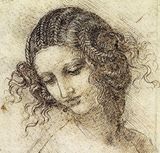
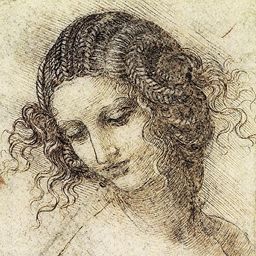
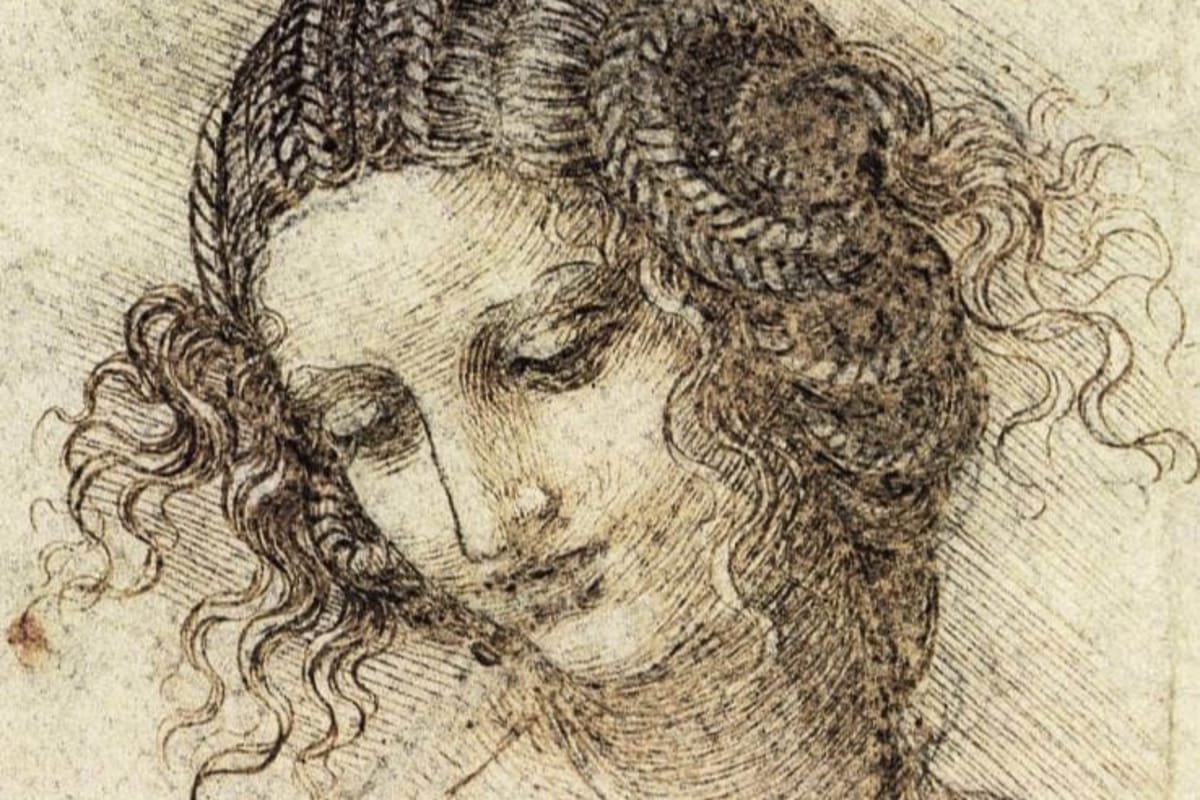
One of the things they say is "sfumato," right? It's da Vinci's ability for everything to go up in smoke.
Vision without execution is hallucination. But I also came to believe that his ability to blur the line between reality and fantasy, just like his sfumato techniques for blurring the lines of a painting, was a key to his creativity. Skill without imagination is barren. Leonardo knew how to marry observation and imagination, which made him history’s consummate innovator.
Leonardo Da Vinci - Walter Isaacson
I think that relates to the concept that an intelligent person can live in paradox and not be broken by it.
The paradox of common sense, therefore, is that even as it helps us make sense of the world, it can actively undermine our ability to understand it.
Everything Is Obvious - Duncan J. Watts
[3 minutes]
You need to be able to be partially collapsed and partially completed at any given time. Our minds are just houses of cards held up in this suspended space of belief.

Whether your beliefs are religious, scientific, about yourself, or about other people—or if you don't have any at all—you need to be able to functionally operate in a world where there are rigid beliefs.
It’s silly to try to escape other people’s faults. They are inescapable. Just try to escape your own.
Meditations - Marcus Aurelius
But you also need to carve out a niche, a cave for yourself, where you can functionally be who you want to be. That is how I hold up in my space.
[4 minutes]
“You drive over to Suspension Bridge,” wrote Mark Twain, “and divide your misery between the chances of smashing down two hundred feet into the river below, and the chances of having a railway-train overhead smashing down onto you. Either possibility is discomforting taken by itself, but, mixed together, they amount in the aggregate to positive unhappiness.”
--The Great Bridge - David McCullough
Every diagonal stay, Roebling explained, formed the hypotenuse of a right triangle (the bridge floor and the tower forming the shorter sides) and thus provided tremendous stability, since, as he said, “The triangle is the only unchangeable figure known in geometry . . .”
--The Great Bridge - David McCullough
The following morning one of the party, a man named Cary, reported sick. He had made the mistake, he said, of drinking some of the local water, a glass of which was described as eating and drinking combined.
--The Great Bridge - David McCullough
He clutched the warglaives tight. In the past, they had killed demons. Now they would kill elves. The thought did not disturb him as once it would have. He would even take pleasure in it.
--Illidan - William King
AUTOBIOGRAPHICAL FICTION REQUIRES AS much research as any other kind of fiction, in my experience. I bought books about sexual abuse, the predatory patterns of pedophiles, and a self-help book for survivors, which I needed more than I knew. I bought a book about the flora and fauna of Maine in every season. I took out my old sheet music from the choir.
--How to Write an Autobiographical Novel - Alexander Chee
I also bought a weathered copy of Aristotle’s Poetics at a library sale.
--How to Write an Autobiographical Novel - Alexander Chee
All I know is that at some point, in deciding to address this need for story, for plot, and catharsis, I turned to Aristotle. The book is remarkable for many reasons, including the pleasure to be found in reading Aristotle on tragedy, as if it has just been invented, speaking confidently about how no one knows the origins of comedy, but that probably it is from Sicily.
--How to Write an Autobiographical Novel - Alexander Chee
Memorable action is always more important to a story—action can even operate the way rhyme and meter do, as a mnemonic device. You remember a story for what people did.
--How to Write an Autobiographical Novel - Alexander Chee
the Greek word katharsis, which occurs only here in the Poetics, is not defined by Aristotle and its meaning is much controverted. Pity and fear and grand action. And purification. This was what I was after.
--How to Write an Autobiographical Novel - Alexander Chee
Reading Aristotle to learn how to structure a novel means reading at an angle
--How to Write an Autobiographical Novel - Alexander Chee
in the section on scale, of “an animal a thousand miles long—the impossibility of taking it all in at a single glance,” and understanding that, while he was speaking of scale in the story, this was, in a sense, what a novel was: a thought so long it could not be perceived all at once.
--How to Write an Autobiographical Novel - Alexander Chee
A single grand action unifies a story more than a single person, the characters memorable for the parts they play inside it.
--How to Write an Autobiographical Novel - Alexander Chee
I was interested in this idea of the self brought to a confrontation with the past through the structure of the narration. I found that writing in the present tense acted as self-hypnosis. Discussions of the use of the tense speak often of the effect on the reader, but the effect on the writer is just as important. Using it casts a powerful spell on the writer’s own mind.
--How to Write an Autobiographical Novel - Alexander Chee
The present is the verb tense of the casual story told in person, to a friend—So I’m at the park, and I see this woman I almost recognize . . .—a gesture many of us use.
--How to Write an Autobiographical Novel - Alexander Chee
I tell my students all the time: writing fiction is an exercise in giving a shit—an exercise in finding out what you really care about. Many student writers become obsessed with aesthetics, but I find that is usually a way to avoid whatever it is they have to say. My first novel was not the first one I started. It was the first one I finished.
--How to Write an Autobiographical Novel - Alexander Chee
She was wearing spectator pumps and a white Burberry Prorsum trench coat, belted, the collar up. A hapless-looking skinny boy, his arm covered in sleeves of tattoos, accompanied her. He was dressed in a trucker hat, expensive jeans, and a wifebeater shirt, and he looked around in dismay, as if there might be some hidden exit in the elevator he could use, if only he could find it.
--How to Write an Autobiographical Novel - Alexander Chee
The elevator descended quietly, and somewhere around the tenth floor she said, without looking at him, “Did you give them my name?” He said nothing as the elevator descended. I remembered it was Fashion Week; the Marc Jacobs show was that morning. She was likely on her way, though it could have been anywhere, anything. “Did you. Give them. My. Name?”
--How to Write an Autobiographical Novel - Alexander Chee
The elevator became a little theater of her. The doors would open and she would be there, sometimes dressed very elegantly, sometimes in a tank top and Daisy Dukes, a bottle of Woolite perched on her hip, going to the basement to do a little laundry. It was the best ad Woolite never had.
--How to Write an Autobiographical Novel - Alexander Chee
I don’t remember what she was wearing then because my mind went white. It still seems to me she is more beautiful in person, or on film, than in photos. Something happens across moments with her that isn’t apparent in a still. “Is it for sale?” she asked, her direct attention blinding me. I tried to stay calm as I answered. “Yes, it is.”
--How to Write an Autobiographical Novel - Alexander Chee
Here in front of me, Chloë was like an apparition, an emanation of all of that money, ambition, and desire, glowing as she walked the rooms. My impostor self wasn’t going to let her know that I was not just like her, not now, not in the face of our idol. And so I felt myself nod at the idea that it was cheap, like I agreed. But now the extent of my charade was apparent to me,
--How to Write an Autobiographical Novel - Alexander Chee
“It’s a steal,” she said, looking out at the view and turning back to me. “She has to buy this, don’t you think? I mean, the view is so beautiful. She’d be stupid not to buy it.” I nodded—I didn’t know her friend—and gave her the broker’s card, and then she left.
--How to Write an Autobiographical Novel - Alexander Chee
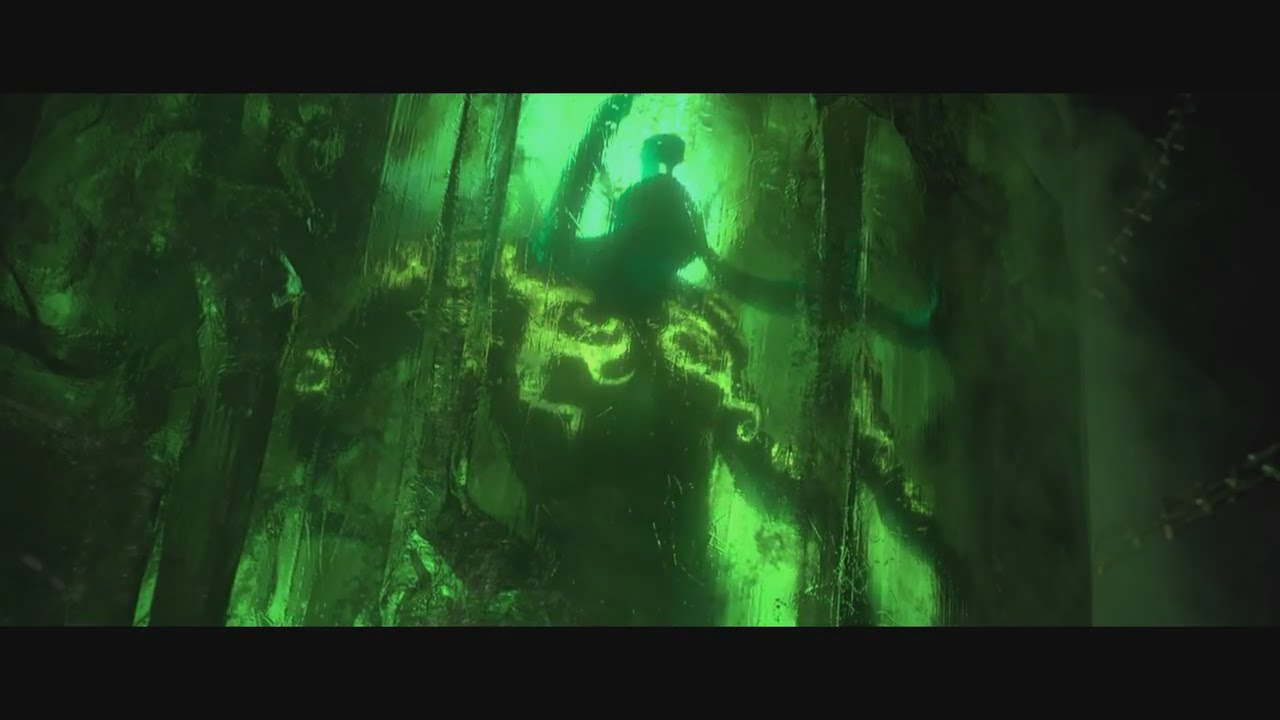
There was no escape from this place. Not even death. Spells healed any harm he might inflict on himself. Magic kept him alive without need for water or food. Those bonds had been woven by masters, drawn so tight, intertwined so deeply, that they could be undone only by those who had buried him alive. And they would never do that.
--Illidan - William King
That was the worst of it. Millennia spent in darkness, trapped in this cage, unable to take more than nine steps in any direction. He who had once hunted demons across the trackless wildernesses of Azeroth had been confined in a place he would not have left an animal.
--Illidan - William King
The reason for so much distrust of suspension bridges was simply that so many of them had come crashing down over the years, and frequently with tragic consequences. In England in 1831 a suspension bridge had collapsed under the feet of marching troops. ... In France in 1850 another wire bridge had failed under almost identical circumstances, killing two hundred men.
--The Great Bridge - David McCullough
But this bridge was not simply for carriages and pedestrians, like the one upstream, indeed, like every other suspension bridge in the world at the time. It carried a railroad. That thought alone was enough to command the respect of anyone who knew a little about bridge engineering or recalled when it had been built.
--The Great Bridge - David McCullough
But even if a person were ignorant of such things, the sight of a moving train held aloft above the great gorge at Niagara by so delicate a contrivance was, in the 1860’s, nothing short of miraculous. The bridge seemed to defy the most fundamental laws of nature. Something so slight just naturally ought to give way beneath anything so heavy. That it did not seemed pure magic.
--The Great Bridge - David McCullough
A house that has been experienced is not an inert box. Inhabited space transcends geometrical space.
--The Poetics of Space - Gaston Bachelard
The inhabitant of La Redousse must dominate solitude in a house on an island where there is no village. He must attain to the dignity of solitude that had been achieved by one of his ancestors, who had become a man of solitude as a result of a deep tragedy in his life. He must live alone in a cosmos which is not that of his childhood.
--The Poetics of Space - Gaston Bachelard
And so, faced with the bestial hostility of the storm and the hurricane, the house’s virtues of protection and resistance are transposed into human virtues. The house acquires the physical and moral energy of a human body. It braces itself to receive the downpour, it girds its loins. When forced to do so, it bends with the blast, confident that it will right itself again
--The Poetics of Space - Gaston Bachelard
Such a house as this invites mankind to heroism of cosmic proportions. It is an instrument with which to confront the cosmos. And the metaphysical systems according to which man is “cast into the world” might meditate concretely upon the house that is cast into the hurricane, defying the anger of heaven itself.
--The Poetics of Space - Gaston Bachelard
However subtle, however indirect, hidden or contrived a human act of aggression may be, it reveals an origin that is unredeemed. In the tiniest of hatreds, there is a little, live, animal filament. And the poet-psychologist—or the psychologist-poet, if such a one exists—cannot go wrong in marking the different types of aggression with an animal cry.
--The Poetics of Space - Gaston Bachelard
It is also a terrible trait of men that they should be incapable of understanding the forces of the universe intuitively, otherwise than in terms of a psychology of wrath.
--The Poetics of Space - Gaston Bachelard
With what art, to begin with, he achieves absolute silence, the immensity of these silent stretches of space! “There is nothing like silence to suggest a sense of unlimited space. Sounds lend color to space, and confer a sort of sound body upon it. But absence of sound leaves it quite pure and, in the silence, we are seized with the sensation of something vast and deep and boundless.
--The Poetics of Space - Gaston Bachelard
“If you are counting your enemies, you should not count me among them, sir,” Anatole said.
--The Poisonwood Bible - Barbara Kingsolver
“First of all, young man, I do not fear any man in Kilanga. I am a messenger of God’s great good news for all mankind, and He has bestowed upon me a greater strength than the brute ox or the most stalwart among the heathen.” Anatole calmly blinked at that. I reckon he was wondering which one Father had him pegged for, brute ox or stalwart heathen.
--The Poisonwood Bible - Barbara Kingsolver
Then all of a sudden the fire hit the pan. Anatole leaned forward and announced, “Our chief, Tata Ndu, is concerned about the moral decline of his village.” Father said, “Indeed he should be, because so few villagers are going to church.” “No, Reverend. Because so many villagers are going to church.” Well, that stupefied us all for a special moment in time.
--The Poisonwood Bible - Barbara Kingsolver
Tata Ndu worries that the people who go to your church are neglecting their duties.” “Neglecting their duties to false idolatry, you mean to say.” Anatole sighed again. “This may be difficult for you to understand. The people of your congregation are mostly what we call in Kikongo the lenzuka. People who have shamed themselves or had very bad luck or something like that.
--The Poisonwood Bible - Barbara Kingsolver
This is what they feel. Their luck could not get any more bad, you see? So they are interested to try making sacrifices to your Jesus.
--The Poisonwood Bible - Barbara Kingsolver
He also spent some time at the diamond mines down south in Katanga, where he says one-quarter of all the world’s diamonds come from. When he spoke of diamonds I naturally thought of Marilyn Monroe in her long gloves and pursey lips whispering “Diamonds Are a Girl’s Best Friend.”
--The Poisonwood Bible - Barbara Kingsolver
But when I looked at Anatole’s wrinkled brown knuckles and pinkish palms, I pictured hands like those digging diamonds out of the Congo dirt and got to thinking, Gee, does Marilyn Monroe even know where they come from? Just picturing her in her satin gown and a Congolese diamond digger in the same universe gave me the weebie jeebies. So I didn’t think about it anymore.
--The Poisonwood Bible - Barbara Kingsolver
I think writers are often terrifying to normal people—that is, to nonwriters in a capitalist system—for this reason: there is almost nothing they will not sell in order to have the time to write. Time is our mink, our Lexus, our mansion. In a room full of writers of various kinds, time is probably the only thing that can provoke widespread envy, more than acclaim.
--How to Write an Autobiographical Novel - Alexander Chee
“Roses love manure more than just about anything,” she says.
--How to Write an Autobiographical Novel - Alexander Chee
seaweed tea, a noxious brew of seaweed and what I grew up calling “gurry,” down on the Portland waterfront: the remains of gutted fish. “It has a smell too,” she says, “but not until you put it in the pail. And this might be the one thing roses love more than manure.”
--How to Write an Autobiographical Novel - Alexander Chee


