Joining for the Hell of It
Working on Synthesis in YCB





synth testing with joins
As long as you save your medical receipts, you can withdraw money from your HSA tax and penalty free anytime to cover them. Even years later. from The Simple Path to Wealth - JL Collins
genius use of cvs receipt from Romy (@Romy_Holland) on X
Print out your current income statement for the last twelve months, as well as your current accounts payable report, your credit card statements, loan statements, and any other statements related to debt, and your last twelve months of payments made from any of your business bank accounts. If you do not have an income statement ready, just gather the other documents. Go line by line through each expense (past and present), even if you are not incurring the expense anymore, and with the pen, mark the expense with a P for any expense that directly generates (P)rofit; R for any expense that while necessary, can be (R)eplaced with a less expensive alternative; or U for any expense that is (U)necessary for delivering your offering. Review every expense, including salaries, commissions and bonuses for employees, rent for the office, equipment, health care, raw goods, your office Spotify subscription. Everything. If money goes out of the business, we need to categorize it as a P, R, or U. I realize these things can get very subjective, so slant toward sharpening the pencil. Also, consider outside help to get you through this process.* Now circle any expense that is recurring (even if it happens to be in a different amount), meaning it will happen again at least once in the next year or more frequently, such as monthly or weekly. As an FYI, this is why we categorized all of your expenses, including ones that you haven’t incurred in a while; they are indicators of what may be coming down the pike. from Profit First - Mike Michalowicz
The best financial plan is to save like a pessimist and invest like an optimist. from Same as Ever - Morgan Housel
Unfortunately, most of the personal finance community tends to side with Dennis over James. Whether they emphasize reducing your expenses or growing your income, their approach is typically based around one thing—guilt. Between Suzie Orman telling you that buying coffee is equivalent to “peeing away $1 million” and Gary Vaynerchuk asking you whether you are working hard enough, mainstream financial advice is built upon sowing doubt around your decision-making.23 Should you buy that car? How about those fancy clothes? What about a daily latte? Guilt. Guilt. Guilt. from Just Keep Buying - Nick Maggiulli
nothings more punk rock than financial literacy from Tweets From Jack Corbett - @jackcorrbit on Twitter
Sometime in your early to mid-thirties (or 10-15 years after you start) two things will happen: Your career will be hitting its strongest surge and you will be closing in on financial independence. Once 4% of your assets can cover your expenses, consider yourself financially independent. Put another way, financial independence = 25x your annual expenses. That is, if you are living on $20,000 you have reached financial independence with $500,000 invested. from The Simple Path to Wealth - JL Collins
realize that if you’re only preparing for the risks you can envision, you’ll be unprepared for the risks you can’t see every single time. So, in personal finance, the right amount of savings is when it feels like it’s a little too much. It should feel excessive; it should make you wince a little. from Same as Ever - Morgan Housel
Hunter-gatherer slop: “For nearly all of human history up until a minute ago, we walked around killing animals and having a fairly nice life. She should leave the cubicle and join a tribe.” from Boring_Business on X: "Posts like these always invite the same 4 types of responders 1. Boomer slop: “we used to work in the coal mines. You work in an AC office. Get over yourself” 2. Manosphere slop: “she is meant to be birthing children instead” 3. Zohran slop: “capitalism is evil. this is why we" / X
Hunter-gatherers walk in minimal sandals or barefoot, they usually carry food and babies, and they either bushwhack or tread on the simplest of trails on varied terrains. Until a few generations ago, no one ever walked in cushioned, supportive shoes on hard, flat sidewalks, let alone treadmills. from Exercised - Daniel Lieberman
Anthropologists long ago established that almost without exception, hunter-gatherers rarely “work” more than three or four hours per day, and these activities are “integrated with rituals, socialization, and artistic expression to a degree unknown to most people in Western societies,” as John Gowdy explains. from Civilized to Death - Christopher Ryan
Until the end of the last Ice Age, around 11,000 B.C., all peoples on all continents were still hunter-gatherers. from Guns, Germs, and Steel - Jared Diamond
hunter-gatherers in the Kalahari spend only two to three hours a day foraging for food. from Exercised - Daniel Lieberman
typical hunter-gatherers are about as physically active as Americans or Europeans who include about an hour of exercise in their daily routine. from Exercised - Daniel Lieberman


Most walls are write-on/wipe-off, so if inspiration hits on the way to the restroom, you can quickly sketch out an idea for your colleagues to see. The traditional kitchenette with a coffeepot and refrigerator is replaced by open “mixer stations” where employees gather to share ideas or gossip. In a sense, Clarkson built the water-coolers first, and then designed an office building around them. from Where Good Ideas Come From - Steven Johnson
The office has become the enemy of deep, focused work. There is a reason people came in early and stayed late: it was the only time they had to get actual work done from Remote Startups Will Win the War for Top Talent - Chris Herd
I Built an Office Pod on the Ceiling - Morley Kert from I Built an Office Pod on the Ceiling - Morley Kert
Ethnology, the study of “simple” people, is the most melancholy of all sciences. How painfully and precise, how rigorously, how strenuously have people held on to their ancient institutions and yet still died out. from The Book Against Death - Elias Canetti, Joshua Cohen, and Peter Filkins
“Damn it, I’m talking about Marx!” This was Richard Shweder’s culture. I had been granted a fellowship to work with Shweder for two years after I finished my Ph.D. at Penn. Shweder was the leading thinker in cultural psychology—a new discipline that combined the anthropologist’s love of context and variability with the psychologist’s interest in mental processes.8 A dictum of cultural psychology is that “culture and psyche make each other up.”9 In other words, you can’t study the mind while ignoring culture, as psychologists usually do, because minds function only once they’ve been filled out by a particular culture. And you can’t study culture while ignoring psychology, as anthropologists usually do, because social practices and institutions (such as initiation rites, witchcraft, and religion) are to some extent shaped by concepts and desires rooted deep within the human mind, which explains why they often take similar forms on different continents. from The Righteous Mind - Jonathan Haidt
Since man is a moment in astronomic time, a transient guest of the earth, a spore of his species, a scion of his race, a composite of body, character, and mind, a member of a family and a community, a believer or doubter of a faith, a unit in an economy, perhaps a citizen in a state or a soldier in an army, we may ask under the corresponding heads—astronomy, geology, geography, biology, ethnology, psychology, morality, religion, economics, politics, and war—what history has to say about the nature, conduct, and prospects of man. It is a precarious enterprise, and only a fool would try to compress a hundred centuries into a hundred pages of hazardous conclusions. We proceed. from The Lessons of History - Will Durant and Ariel Durant
We call ourselves by many names: Homo sapiens, man the wise; Homo habilis, man the able, the toolmaker; and, perhaps the most appropriate, Homo ludens, man the playful. Each aspect makes its contributions to science. There is no one way, for our exploration depends on all three: wisdom to choose the ill-lit path; techniques to find the answers; but always, always beneath the surface, playfulness. “Theory is the free invention of the human mind,” said Einstein, one whose wisdom and technique were almost beyond our ken, but at base, one who could play with the utmost freedom. from At Home in the Universe - Stuart A. Kauffman
aim to do the bare minimum at work for the next two months, for example, while you focus on your children, or let your fitness goals temporarily lapse while you apply yourself to election canvassing. Then switch your energies to whatever you were neglecting. To live this way is to replace the high-pressure quest for “work-life balance” with a conscious form of imbalance from Four Thousand Weeks - Oliver Burkeman
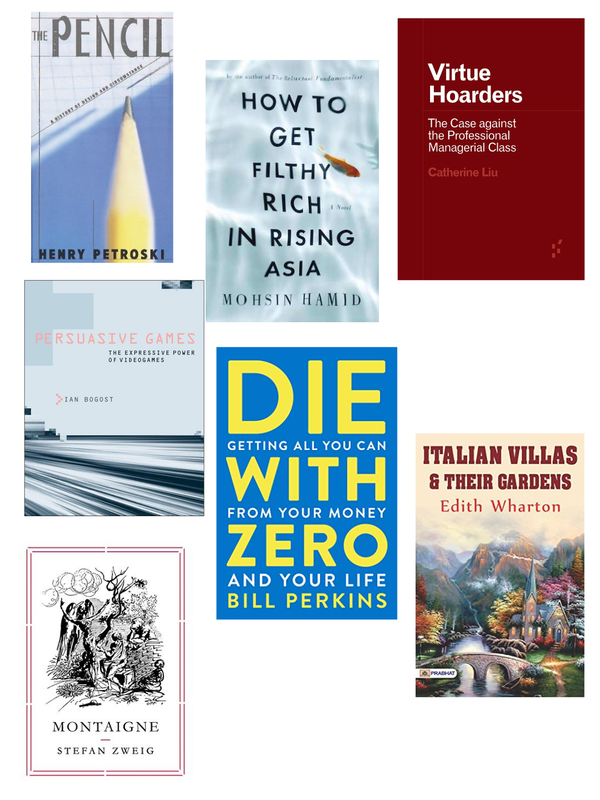
Think about the 3 basics people need to get the most out of life: health free time money from Die With Zero - 9 Minute Book Summary - Debt-Free Doctor - Jeff Debtfreedr.Com
Or or hear me out, normalise working fewer hours so you can nap at your fucking home and have a fucking life https://t.co/uWtuKq8VfI from Tweets From Eusebio - @eu_JRF on Twitter
me, garfield’s vet: feeding him WHAT from Tweets from nate of the living dead - @MNateShyamalan on Twitter

The image depicts two animated characters in a close-up, intense pose. One character, with muscular arms and a prominent expression, appears to be exerting force or strength, while the other character looks distressed or surprised. Their facial expressions are quite exaggerated, conveying a sense of drama.
There is no text present in the image. from This Streamer’s Never Wrong… - Frame at 2:34
That was a core inspiration for his original Samurai Jack (2001–2004). “There are so many sitcoms, especially in animation, that we’ve almost forgotten what animation was about — movement and visuals,” he told the press after the show debuted. The Samurai Jack crew aimed to “tell the stories visually… tell a very simple story visually.” from The Visual World of 'Samurai Jack'

The image features two animated characters. The character on the left has large, circular eyes and a surprised expression with hands on their cheeks. The character on the right appears shocked or surprised, with hands raised to their head. In the background, there is a small box containing what looks like a pile of white items, possibly food. There is no visible text in the image. from "DEMON SLAYER RECAP ALL COMPLETE EDITION" - Frame at 4:30

The image features three animated characters against a backdrop of fireworks.
- The character on the left is muscular with large arms and is embracing the character in the middle, who has a surprised expression, wearing a polka-dotted dress and a halo.
- The middle character appears startled or surprised.
- The character on the right is lying on the ground with a shocked expression, featuring large, round eyes with reflections, looking up at the fireworks.
There is no text in the image. from "Demon slayer infinite castle recap complete edition" - Frame at 3:01