More Important than Opinion
Essays in Skepticism Comprehension Quiz

Quiz
. essays in skepticism — bertrand russell
- what does russell claim is more important than what your opinions are?
a) how you arrive at them
b) how popular they are
c) how emotional they are
d) whether they agree with others
2. the world beyond your head — matthew b. crawford
- according to the “prevailing notion” of freedom, what is freedom primarily about?
a) self-discipline
b) the ability to satisfy preferences
c) moral responsibility
d) collective well-being
3. principles — ray dalio
- dalio says people should think for themselves to decide what three things?
a) what is true, what is moral, what is practical
b) what you want, what is true, what you should do
c) what others think, what works, what is safe
d) what feels right, what is easy, what is fun
4. the beginning of infinity — david deutsch
- how does deutsch define a “good explanation”?
a) one that’s hard to vary without breaking it
b) one that fits the data best
c) one supported by authority
d) one that feels intuitively true
Answers
- a) how you arrive at them
- b) the ability to satisfy preferences
- b) what you want, what is true, what you should do
- a) one that’s hard to vary without breaking it
conversational / reflection prompts
russell:
do you think uncertainty is a weakness or a strength in reasoning — and how do you tell the difference between healthy doubt and indecision?
crawford:
if freedom is defined by the ability to satisfy preferences, what happens when our preferences themselves are shaped by advertising, social media, or culture?
dalio:
how can humility coexist with strong conviction — when do you stop being open-minded and start acting?
deutsch:
deutsch says knowledge grows through conjecture and criticism, not authority — how does that apply to how you learn or make creative work?
Transcript
... facts about Bertrand Russell: he was a mathematician and a political philosopher in the late 1800s and early 1900s. ...
 Contributors to Wikimedia projects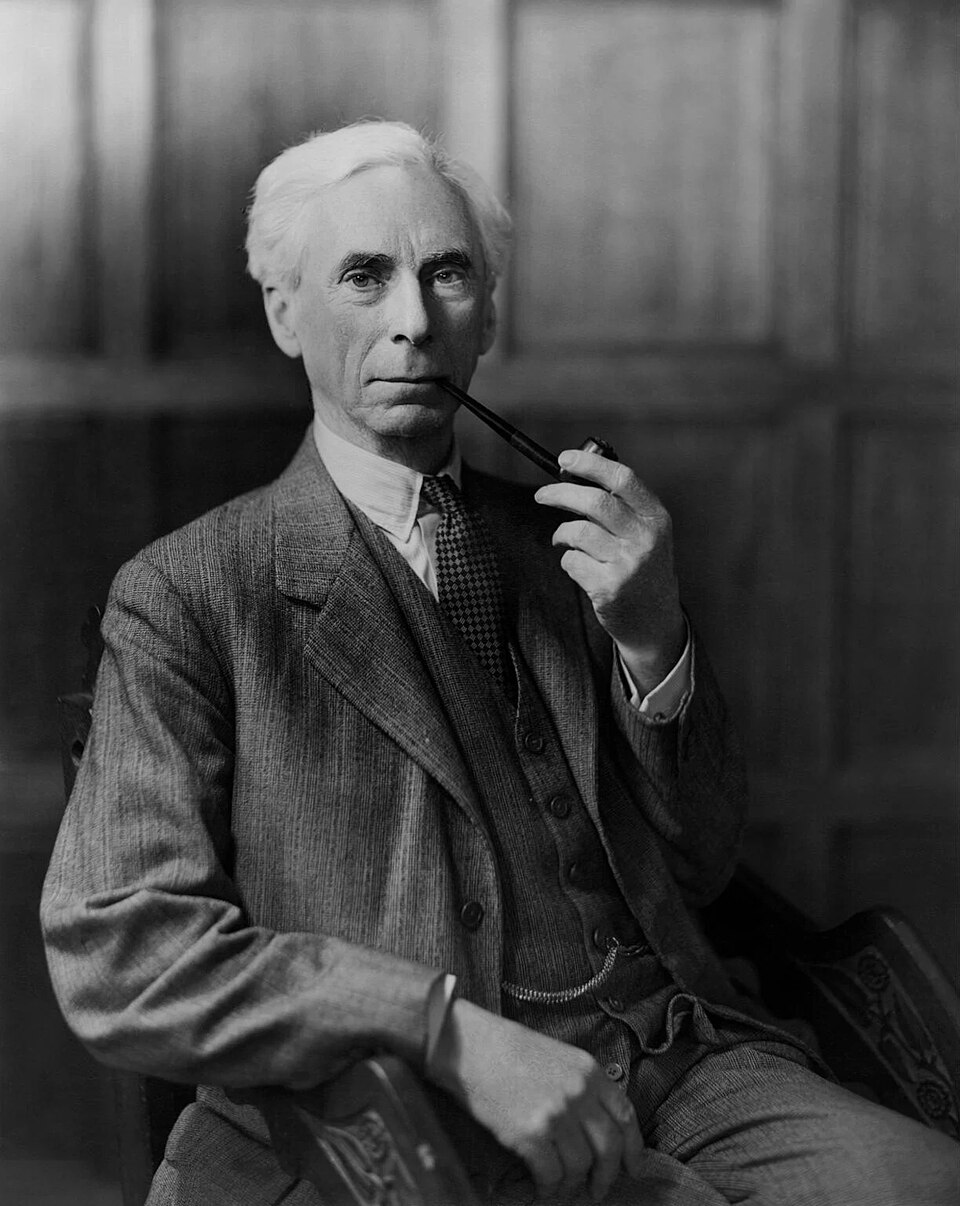
[1 minute]
... Emotions are useful, of course, and they can provide useful data, but that's just another piece of data. It's not the end-all be-all, which sometimes they get treated as in modern society. ...
The Mindbody Prescription - John E. Sarno
People who study the emotions and psychosomatic medicine must overcome the inferiority complex that stems from their inability to use the tools of “hard science.” I refer to another Gould essay: This unnecessary humility follows an unfortunate tradition of self-hate among scientists who deal with the complex, unrepeatable and unpredictable events of history [substitute “the complex, poorly understood realm of human emotions”]. We are trained to think that the “hard science” models of quantification, experimentation and replication are inherently superior and exclusively canonical, so that any other set of techniques can only pale by comparison. But historical science proceeds by reconstructing a set of contingent events, explaining in retrospect what could not have been predicted beforehand. If the evidence be sufficient, the explanation can be as rigorous and confident as anything done in the realm of experimental science. In any case, this is the way the world works; no apologies needed.
In Praise of the Gods - Simon Sarris
Modern science is drunk on both certainty and consensus, with all the grave mistakes to show for it. The inventor of the lobotomy was awarded a Nobel Prize, never rescinded, which is telling not only of modern science but also the nature of awards.
As the underlying results of bad science accumulate untested, an opening is created for moneyed interests to insert themselves into the process. Research suffers. There is no shortage of examples. Fake data is rampant in every field, most egregiously nutrition and health, which has for sixty years repackaged flawed research as public health guidelines, prompting mass diet changes that continue to kill millions. Such poor research practices show no signs of stopping. Modern social sciences are so filled with fraudulent studies that a book of fables or a good history book will teach volumes more about psychology than any psychology textbook printed today, and it will do so with fewer delusions.
Today’s scientists do not need better tools, they need to rent a dumpster. Hiring thousands of science janitors would be a better use of research funding than adding a single new paper to a mountain of research that is already half fraudulent.
Alchemy comes from a time when people considered science a process and a philosophy, and took allegories seriously enough to learn from them. This shows in their thinking: Paracelsus rejected the theory of humors, supposing that illness must come from impure agents originating outside the body. Rather than by blood-letting, or the idea that infections were a natural part of the body’s healing, Paracelsus found success by keeping wounds clean. He brought chemistry to medicine, and it is he who coined the still-popular phrase, “The dose makes the poison.” His writings themselves are hermetical, though sometimes he gives plain advice:
“The universities do not teach all things. A doctor must seek out old wives, gypsies, sorcerers, wandering tribes, old robbers, and such outlaws and take lessons from them. A doctor must be a traveller because he must enquire of the world. Experiment is not sufficient. Experience must verify what can be accepted or not accepted.”
[2 minutes]
... the prevailing notion of freedom, it's going to be more related to the hedonistic form of freedom, which is the ability to satisfy pleasure and preferences. ...
The World Beyond Your Head - Matthew B. Crawford
According to the prevailing notion, to be free means to be free to satisfy one’s preferences. Preferences themselves are beyond rational scrutiny; they express the authentic core of a self whose freedom is realized when there are no encumbrances to its preference-satisfying behavior. Reason is in the service of this freedom, in a purely instrumental way; it is a person’s capacity to calculate the best means to satisfy his ends. About the ends themselves we are to maintain a principled silence, out of respect for the autonomy of the individual.
...There's obviously a moralistic arc there with how we conceive of Puritan values and the quote-unquote value of hard work. ...
In Praise of Idleness, by Bertrand Russell - Bertrand Russell
From the beginning of civilization until the industrial revolution a man could, as a rule, produce by hard work little more than was required for the subsistence of himself and his family, although his wife worked at least as hard and his children added their labor as soon as they were old enough to do so. The small surplus above bare necessaries was not left to those who produced it, but was appropriated by priests and warriors. In times of famine there was no surplus; the warriors and priests, however, still secured as much as at other times, with the result that many of the workers died of hunger. This system persisted in Russia until 1917, and still persists in the East; in England, in spite of the Industrial Revolution, it remained in full force throughout the Napoleonic wars, and until a hundred years ago, when the new class of manufacturers acquired power. In America the system came to an end with the Revolution, except in the South, where it persisted until the Civil War. A system which lasted so long and ended so recently has naturally left a profound impression upon men’s thoughts and opinions. Much that we take for granted about the desirability of work is derived from this system and, being pre-industrial, is not adapted to the modern world. Modern technic has made it possible for leisure, within limits, to be not the prerogative of small privileged classes, but a right evenly distributed throughout the community. The morality of work is the morality of slaves, and the modern world has no need of slavery.
... There's a non-zero set Venn diagram of things that people can enjoy that also count as work and push us towards this feeling of providing value to other members of our society and ourselves. ...
[3 minutes]
... "take what you want and pay for it," ...

[4 minutes]
... you need to think about what you want, and then you need to juxtapose that against what is already true in the universe, and then what you should do knowing those two things. ...
Super Thinking - Gabriel Weinberg, Lauren McCann
To avoid mental traps, you must think more objectively. Try arguing from first principles, getting to root causes, and seeking out the third story. Realize that your intuitive interpretations of the world can often be wrong due to availability bias, fundamental attribution error, optimistic probability bias, and other related mental models that explain common errors in thinking. Use Ockham’s razor and Hanlon’s razor to begin investigating the simplest objective explanations. Then test your theories by de-risking your assumptions, avoiding premature optimization. Attempt to think gray in an effort to consistently avoid confirmation bias. Actively seek out other perspectives by including the Devil’s advocate position and bypassing the filter bubble. Consider the adage “You are what you eat.” You need to take in a variety of foods to be a healthy person. Likewise, taking in a variety of perspectives will help you become a super thinker.
101 Essays That Will Change the Way You Think - Brianna Wiest
Practice rational thinking, and often. You shouldn’t trust your mind to think healthfully on autopilot. You have to train it.
... Persephone and Hades and kind of the explanation that the seasonal change is brought about by, you know, Persephone going down for a number of months to go be with Hades. And then the disprovement of that is more along the lines of it's way too easy to move the goalposts. ...
The Beginning of Infinity - David Deutsch
Long ago, Hades, god of the underworld, kidnapped and raped Persephone, goddess of spring. Then Persephone’s mother, Demeter, goddess of the earth and agriculture, negotiated a contract for her daughter’s release, which specified that Persephone would marry Hades and eat a magic seed that would compel her to visit him once a year thereafter. Whenever Persephone was away fulfilling this obligation, Demeter became sad and would command the world to become cold and bleak so that nothing could grow. That myth, though comprehensively false, does constitute an explanation of seasons: it is a claim about the reality that brings about our experience of winter. It is also eminently testable: if the cause of winter is Demeter’s periodic sadness, then winter must happen everywhere on Earth at the same time. Therefore, if the ancient Greeks had known that a warm growing season occurs in Australia at the very moment when, as they believed, Demeter is at her saddest, they could have inferred that there was something wrong with their explanation of seasons.
[5 minutes]
... It's really important for ideas that are explanations for things to have falsifiability. They need to be able to be checked against something. ...
Astrophysics for People in a Hurry - Neil deGrasse Tyson
Perhaps one day we will learn that Newton’s gravity indeed requires adjustment. That’ll be okay. It has happened once before. Einstein’s 1916 general theory of relativity expanded on the principles of Newton’s gravity in a way that also applied to objects of extremely high mass. Newton’s law of gravity breaks down in this expanded realm, which was unknown to him. The lesson here is that our confidence flows through the range of conditions over which a law has been tested and verified. The broader that range, the more potent and powerful the law becomes in describing the cosmos. For ordinary household gravity, Newton’s law works just fine. It got us to the Moon and returned us safely to Earth in 1969. For black holes and the large-scale structure of the universe, we need general relativity. And if you insert low mass and low speeds into Einstein’s equations they literally (or, rather, mathematically) become Newton’s equations—all good reasons to develop confidence in our understanding of all we claim to understand.
The Beginning of Infinity - David Deutsch
Appearances are deceptive. Yet we have a great deal of knowledge about the vast and unfamiliar reality that causes them, and of the elegant, universal laws that govern that reality. This knowledge consists of explanations: assertions about what is out there beyond the appearances, and how it behaves. For most of the history of our species, we had almost no success in creating such knowledge. Where does it come from? Empiricism said that we derive it from sensory experience. This is false. The real source of our theories is conjecture, and the real source of our knowledge is conjecture alternating with criticism. We create theories by rearranging, combining, altering and adding to existing ideas with the intention of improving upon them. The role of experiment and observation is to choose between existing theories, not to be the source of new ones. We interpret experiences through explanatory theories, but true explanations are not obvious. Fallibilism entails not looking to authorities but instead acknowledging that we may always be mistaken, and trying to correct errors. We do so by seeking good explanations – explanations that are hard to vary in the sense that changing the details would ruin the explanation. This, not experimental testing, was the decisive factor in the scientific revolution, and also in the unique, rapid, sustained progress in other fields that have participated in the Enlightenment. That was a rebellion against authority which, unlike most such rebellions, tried not to seek authoritative justifications for theories, but instead set up a tradition of criticism. Some of the resulting ideas have enormous reach: they explain more than what they were originally designed to. The reach of an explanation is an intrinsic attribute of it, not an assumption that we make about it as empiricism and inductivism claim.
[6 minutes]
...I think that we live in a world right now where it's filled with people who can talk really loud, and I think a good example of this is the current sitting president, Donald Trump, who will just distort reality to remove uncertainty, saying like, "Oh, no, no, America's doing great right now because I'm in charge," or "It was doing bad a few months ago, but that was still the Biden economy," right? ...
 Contributors to Wikimedia projects
 Contributors to Wikimedia projects
[7 minutes]
... The difference between healthy doubt and indecision, however, is that doubt doesn't preclude you from taking action; indecision does. ...
Getting Things Done - David Allen
Thought is useful when it motivates action and a hindrance when it substitutes for action.
[8 minutes]
... We're just animals, so if you surround yourself with trash—garbage in, garbage out—it's really as simple as that. ...
... Do quizzes and test the limits of your thinking, and the effects of advertising and social media will be less poignant and less perhaps poisoning. But that only works at the individual level; it doesn't work at the cultural level. ...
The State of the Culture - Ted Gioia
But let’s turn around and look at those folks in the audience. It’s sobering to see what they’re actually doing. Consumers of culture have so many options to choose from—so what do they pick?
The brutal truth is that there’s an ocean of stuff out there, but consumers sip it with a narrow straw.
You can tell a lot about the future by looking at teenagers. What that data tells us is that they pick a web platform—often only one—and it becomes their prism for evaluating the entire world.
[9 minutes]
I think you can be open-minded and start acting. I don't think that these two are mutually exclusive.
... An engineer is a person who can take a concept and not become too attached to it and iterate through the versions of that concept until they find something that works, and they don't get stuck in any particular version. ...

Bad science is, however, when you change the evidence to match your propositions—your prepositions—which also happens from time to time in the modern scientific world, unfortunately.
Super Thinking - Gabriel Weinberg, Lauren McCann
Individuals still hang on to old theories in the face of seemingly overwhelming evidence—it happens all the time in science and in life in general. The human tendency to gather and interpret new information in a biased way to confirm preexisting beliefs is called confirmation bias.
[10 minutes]
... keeping scientific journals of your efforts. ...
(https://www.utoledo.edu/library/info/dir/JoleneMillerKeepingResearchJournal.pdf)
You'll never reach the end of any particular form of knowledge, and it's actually very important that you keep pushing yourself into learning harder and harder subjects whenever possible because that's one of the great gifts of being alive: that the universe allows for our curiosity and seems to have no end.
Curiosity swallows humans. Research always turns into ambition and runs amok.
The Dream Machine - M. Mitchell Waldrop
I was more motivated by curiosity. ... I just wondered how things were put together. Or what laws or rules govern a situation, or if there are theorems about what one can’t or can do. Mainly because I wanted to know myself. After I had found the answers it was always painful to write them up or to publish them (which is how you get the acclaim).