Silence Has Many Advantages
This book is like any other book. But I would be happy if it were only read by people whose souls are already formed.
Books and Authors Mentioned
- Constantine's Sword by James Carroll - Search Google
- Heart of Darkness by Joseph Conrad, Stanley Appelbaum (Editor) - Search Google
- How to Write an Autobiographical Novel by Alexander Chee - Search Google
- Sadly, Porn by Edward Teach - Search Google
- Smoke Gets in Your Eyes by Caitlin Doughty - Search Google
- The Passion According to G.H. by Clarice Lispector, Benjamin Moser, and Idra Novey - Search Google
- The Poisonwood Bible by Barbara Kingsolver - Search Google
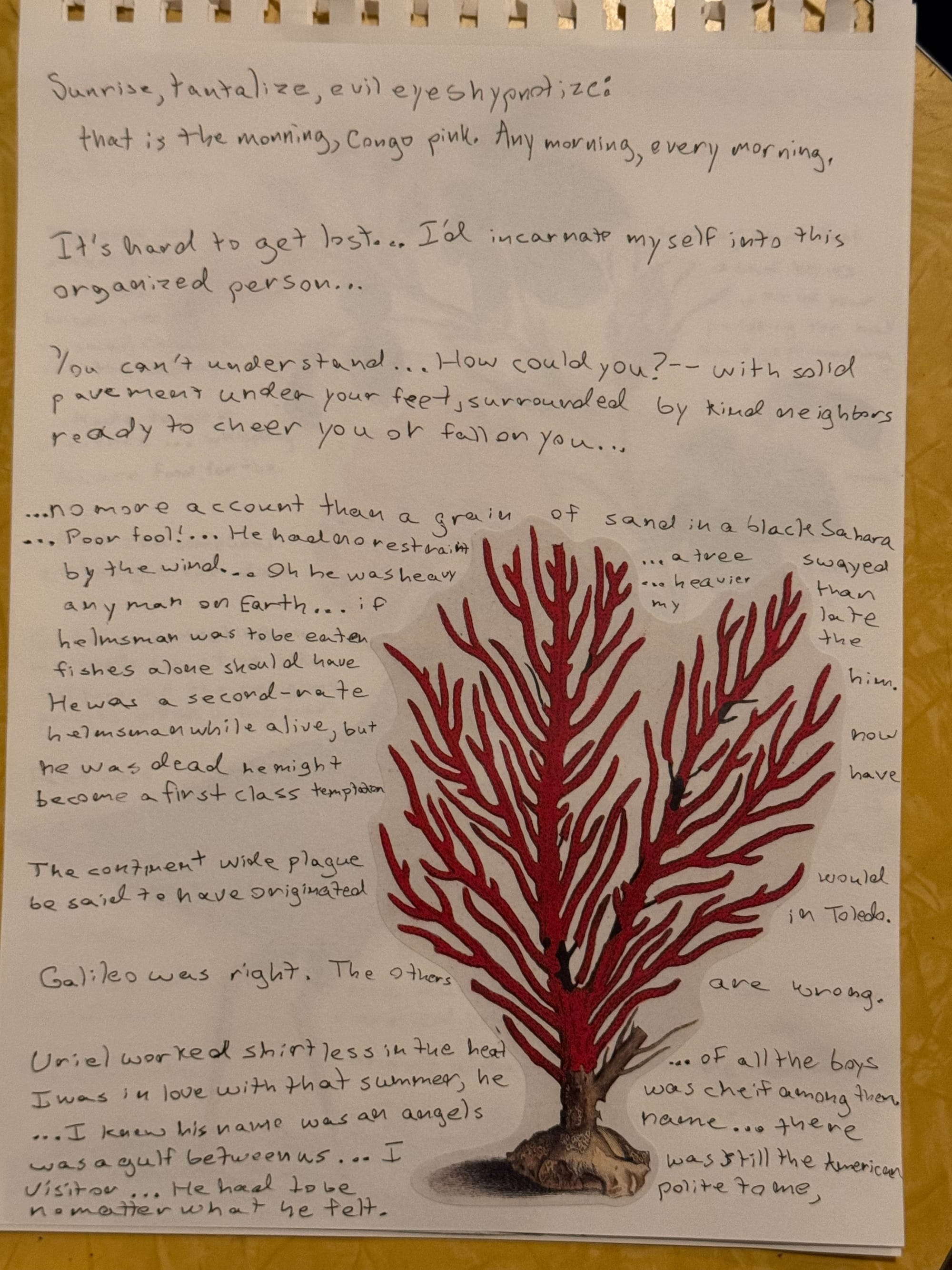
SUNRISE TANTALIZE, evil eyes hypnotize: that is the morning, Congo pink. Any morning, every morning.
--The Poisonwood Bible - Barbara Kingsolver
Men sit on buckets and stare at whatsoever passes by. The usual by passer is a woman sauntering slowly down the road with bundles upon bundles balanced on her head. These women are pillars of wonder, defying gravity while wearing the ho-hum aspect of perfect tedium. They can sit, stand, talk, shake a stick at a drunk man, reach around their backs to fetch forth a baby to nurse, all without dropping their piled-high bundles upon bundles. They are like ballet dancers entirely unaware they are on stage. I cannot take my eyes from them. Whenever a woman leaves her wide-open-to-the-world yard to work her field or saunter off on an errand, first she must make herself decent. To do this, even though she is already wearing a wraparound skirt, she will go and get another large square of cloth from the house, which she wraps around her first skirt—covering her legs right down to the instep of her foot—into a long, narrow sarong tied below her bare breasts. The cloths are brightly printed and worn together in jangling mixtures that ring in my ears: pink gingham with orange plaid, for example. Loose-joint breaking-point colors, and whether you find them beautiful or find them appalling, they do make the women seem more festive, and less exhausted.
--The Poisonwood Bible - Barbara Kingsolver
Silence has many advantages. When you do not speak, other people presume you to be deaf or feeble-minded and promptly make a show of their own limitations. Only occasionally do I find I have to break my peace: shout or be lost in the shuffle. But mostly am lost in the shuffle. I write and draw in my notebook and read anything I please. It is true I do not speak as well as I can think. But that is true of most people, as nearly as I can tell.
--The Poisonwood Bible - Barbara Kingsolver
For news or mail or evidence of what Rachel calls The Pale Which We Are Way Beyond, we wait for the rough-and-ready airplane pilot, Mr. Eeben Axelroot. He is reliable in the following way: if they say he is coming on Monday, it will be Thursday, Friday, or not at all. Like the village road and the river, nothing here really continues to its end. The Congo is only a long path that takes you from one hidden place to another. Palm trees stand alongside of it looking down at you in shock, like too-tall, frightened women with upright hair. Nevertheless, I am determined I will walk that path, even though I do not walk fast or well. My right side drags. I was born with half my brain dried up like a prune, deprived of blood by an unfortunate fetal mishap. My twin sister, Leah, and I are identical in theory, just as in theory we are all made in God’s image. Leah and Adah began our life as images mirror perfect. We have the same eyes dark and chestnut hair. But I am a lame gallimaufry and she remains perfect. Oh, I can easily imagine the fetal mishap: we were inside the womb together dum-de-dum when Leah suddenly turned and declared, Adah you are just too slow. I am taking all the nourishment here and going on ahead. She grew strong as I grew weak. (Yes! Jesus loves me!) And so it came to pass, in the Eden of our mother’s womb, I was cannibalized by my sister. Officially my condition is called hemiplegia. Hemi is half, hemisphere, hemmed-in, hemlock, hem and haw. Plegia is the cessation of motion. After our complicated birth, physicians in Atlanta pronounced many diagnoses on my asymmetrical brain, including Wernicke’s and Broca’s aphasia, and sent my parents home over the icy roads on Christmas Eve with one-half a set of perfect twins and the prediction that I might possibly someday learn to read but would never speak a word. My parents seem to have taken this well in stride. I am sure the Reverend explained to his exhausted wife that it was the will of God, who could plainly see—with these two additional girls so close after the first one—our house had enough females in it now to fill it up with blabber. They did not even have Ruth May yet, but did have a female dog that howled, Our Father still likes to say, Like One Too Many Sopranos in Church. The Dog that Broke The Camel’s Back, he also calls it. Our Father probably interpreted Broca’s aphasia as God’s Christmas bonus to one of His worthier employees.
--The Poisonwood Bible - Barbara Kingsolver
It’s hard to get lost. It’s so hard that I’ll probably quickly figure out some way to find myself, even if finding myself is once again my vital lie. Until now finding myself was already having an idea of a person and fitting myself into it: I’d incarnate myself into this organized person, and didn’t even feel the great effort of construction that is living. The idea I had of what a person is came from my third leg, the one that pinned me to the ground. But, and now? will I be freer?
--The Passion According to G.H. - Clarice Lispector, Benjamin Moser, and Idra Novey
This book is like any other book. But I would be happy if it were only read by people whose souls are already formed. Those who know that the approach, of whatever it may be, happens gradually and painstakingly — even passing through the opposite of what it approaches. They who, only they, will slowly come to understand that this book takes nothing from no one.
--The Passion According to G.H. - Clarice Lispector, Benjamin Moser, and Idra Novey
He beat down a square of tall grass and wild pink flowers, all without once ever looking at me. Then he bent over and began to rip out long handfuls of grass with quick, energetic jerks as though tearing out the hair of the world. He wore his cuffed, baggy work khakis and a short-sleeved white shirt, and labored at the center of a rising red cloud of dust like a crew-cut genie who’d just appeared there. A fur of red dust gathered on the curly hairs of his forearms, and rivulets of perspiration ran down his temples. The tendon of his jaw was working, so I knew he was preparing a revelation. The education of his family’s souls is never far from my father’s thoughts. He often says he views himself as the captain of a sinking mess of female minds. I know he must find me tiresome, yet still I like spending time with my father very much more than I like doing anything else. “Leah,” he inquired at last, “why do you think the Lord gave us seeds to grow, instead of having our dinner just spring up out there on the ground like a bunch of field rocks?” Now that was an arresting picture. While I was considering it, he took up the hoe blade that had crossed the Atlantic in our mother’s purse and shoved it onto a long pole he’d whittled to fit its socket. Why did the Lord give us seeds? Well, they were sure easier to stuff in our pockets than whole vegetables would have been, but I doubted if God took any real interest in travel difficulties. I was exactly fourteen and a half that month, and still getting used to the embarrassment of having the monthly visits. I believe in God with all my might, but have been thinking lately that most of the details seem pretty much beneath His dignity. I confessed I didn’t know the answer. He tested the heft and strength of his hoe handle and studied me. He is very imposing, my father, with broad shoulders and unusually large hands. He’s the handsome, sandy-haired type that people presume to be Scottish and energetic, though possibly fiery-tempered. “Because, Leah, the Lord helps those that help themselves.” “Oh!” I cried, my heart rushing to my throat, for of course I had known that. If only I could ever bring forth all that I knew quickly enough to suit Father. “God created a world of work and rewards,” he elaborated, “on a big balanced scale.” He brought his handkerchief out of his pocket to ream the sweat, carefully, out of one eye socket and then the other. He has a scar on his temple and poor vision on the left side, from a war injury he doesn’t ever talk about, not being one to boast. He refolded the handkerchief and returned it to his pocket. Then he handed me the hoe and held his hands out from his sides, palms up, to illustrate the heavenly balancing act. “Small works of goodness over here,” he let his left hand drop slightly, “small rewards over here.” His right hand dropped just a mite with the weight of an almost insignificant reward. “Great sacrifice, great rewards!” he said then, letting both hands fall heavily from the shoulders, and with all my soul I coveted the delicious weight of goodness he cradled in those palms. Then he rubbed his hands together, finished with the lesson and with me. “God merely expects us to do our own share of the perspiring for life’s bounty, Leah.” He took back the hoe and proceeded to hack out a small, square dominion over the jungle, attacking his task with such muscular vigor we would surely, and soon, have tomatoes and beans coming out our ears.
--The Poisonwood Bible - Barbara Kingsolver
You can’t understand. How could you?—with solid pavement under your feet, surrounded by kind neighbors ready to cheer you or to fall on you, stepping delicately between the butcher and the policeman, in the holy terror of scandal and gallows and lunatic asylums—how can you imagine what particular region of the first ages a man’s untrammeled feet may take him into by the way of solitude—utter solitude without a policeman—by the way of silence—utter silence, where no warning voice of a kind neighbor can be heard whispering of public opinion? These little things make all the great difference. When they are gone you must fall back upon your own innate strength, upon your own capacity for faithfulness. Of course you may be too much of a fool to go wrong—too dull even to know you are being assaulted by the powers of darkness. I take it, no fool ever made a bargain for his soul with the devil: the fool is too much of a fool, or the devil too much of a devil—I don’t know which. Or you may be such a thunderingly exalted creature as to be altogether deaf and blind to anything but heavenly sights and sounds. Then the earth for you is only a standing place—and whether to be like this is your loss or your gain I won’t pretend to say. But most of us are neither one nor the other. The earth for us is a place to live in, where we must put up with sights, with sounds, with smells, too, by Jove!—breathe dead hippo, so to speak, and not be contaminated. And there, don’t you see? Your strength comes in, the faith in your ability for the digging of unostentatious holes to bury the stuff in—your power of devotion, not to yourself, but to an obscure, back-breaking business. And that’s difficult enough.
--Heart of Darkness - Joseph Conrad, Stanley Appelbaum (Editor)
I missed my late helmsman awfully—I missed him even while his body was still lying in the pilot house. Perhaps you will think it passing strange this regret for a savage who was no more account than a grain of sand in a black Sahara. Well, don’t you see, he had done something, he had steered; for months I had him at my back—a help—an instrument. It was a kind of partnership. He steered for me—I had to look after him, I worried about his deficiencies, and thus a subtle bond had been created, of which I only became aware when it was suddenly broken. And the intimate profundity of that look he gave me when he received his hurt remains to this day in my memory—like a claim of distant kinship affirmed in a supreme moment. “Poor fool! If he had only left that shutter alone. He had no restraint, no restraint—just like Kurtz—a tree swayed by the wind. As soon as I had put on a dry pair of slippers, I dragged him out, after first jerking the spear out of his side, which operation I confess I performed with my eyes shut tight. His heels leaped together over the little doorstep; his shoulders were pressed to my breast; I hugged him from behind desperately. Oh! he was heavy, heavy; heavier than any man on earth, I should imagine. Then without more ado I tipped him overboard. The current snatched him as though he had been a wisp of grass, and I saw the body roll over twice before I lost sight of it forever. All the pilgrims and the manager were then congregated on the awning deck about the pilot house, chattering at each other like a flock of excited magpies, and there was a scandalized murmur at my heartless promptitude. What they wanted to keep that body hanging about for I can’t guess. Embalm it, maybe. But I had also heard another, and a very ominous, murmur on the deck below. My friends the woodcutters were likewise scandalized, and with a better show of reason—though I admit that the reason itself was quite inadmissible. Oh, quite! I had made up my mind that if my late helmsman was to be eaten, the fishes alone should have him. He had been a very second-rate helmsman while alive, but now he was dead he might have become a first-class temptation, and possibly cause some startling trouble.
--Heart of Darkness - Joseph Conrad, Stanley Appelbaum (Editor)
Jews were taught Arabic by Muslim scholars, and they mastered the Koran as well as Hebrew Scriptures. Mathematics, astronomy, and medicine were complemented by the study of philosophy, based on the entire corpus of Aristotle and much of Plato. Extant scholarly works by Jews, dating to the convivencia period, establish that many Jews mastered these subjects. The most familiar such figure is the Córdoba native Moses ben Maimón, whose writing proves the point: Perhaps the most revered of all Jewish sages, Maimonides wrote in Arabic, not Hebrew. The scholar Norman Roth is one of my important sources for information on the life of Jews in Iberia. He writes, “The names cited by Maimonides in his work read like a Who’s Who of classical and Muslim philosophy and science: Plato and Aristotle, of course; but also Alexander of Aphrodisias, Themistius, John Philoponus, Euclid, Ptolemy, Pythagoras, and almost all of the Muslim philosophers.” Maimonides would not have been Maimonides had he not lived in Iberia, no matter what his genius. “Were he to have been born in another land, France or Germany, for instance,” Roth asserts, “he would at most have become another one of those almost anonymous rabbis who wrote endless commentaries on commentaries on the Talmud.” Because his creativity and intelligence were nurtured by the richest diversity of influences in the world—among the richest in history—Maimonides became “the greatest genius ever produced by the Jewish people.”
--Constantine's Sword - James Carroll
As if shaken by a continent-wide seismic shift, convivencia broke apart into violent imbalance around the time that the crusading fervor first swept through northern Europe. A far stricter sect of militant Muslims, who rejected Iberian intermingling and aesthetics—and the soft life of beauty reflected in the elegant Moorish style—crossed over from North Africa in about 1145, a turn in the story remembered as the Almohad Invasion. For two decades, this puritanical contingent of Muslims fought the ruling Iberian caliphates, as well as Christians and Jews, before finally establishing control, in the south and center.8 But by then, astir with a crusading fervor of their own, the Christian kingdoms in the peninsula’s far north had begun the campaign of reconquista, with the ambition of restoring all of Iberia to Christian control. The Spanish epic poem El Cid dates to this period (c. 1140). Taken as a celebration of Christian resistance to Muslims, it nevertheless carries the curves of convivencia, since the Christian hero ends as a man in the middle, associated as much with Muslims as with his own kind. By the middle of the twelfth century, in the thick of the crusading era, the time of tolerance was passing. When the Christian Alfonso VII conquered Córdoba in 1146, he ordered a cross put atop the Great Mosque, in which, before the Almohads, Catholic Masses had been freely celebrated. King Alfonso declared that henceforth the mosque would be a church. The Muslims would recapture Córdoba in short order, and would remove the cross. They struck out at Christians and Jews alike, with unprecedented ruthlessness. Perhaps the most striking signal of the demise of convivencia was the decision, in 1159, by the brilliant twenty-four-year-old Maimónides to abandon Córdoba, because Jews there were being forcibly converted or murdered by the now fanatical Almohads. Maimonides fled with his family to Egypt, where he would become famous as a physician. He never returned to Iberia. In tribute to his stature, he became known as a second “Moses the Egyptian,” although he always identified himself as an Iberian.
--Constantine's Sword - James Carroll
Toledo was called the Jerusalem of Spain, and some accounts trace its founding to Jews well before the birth of Christ. One conjecture has it that the name itself evolved from Hebrew. Among the Christians who so positively interacted with Toledo’s Jews a tradition developed that they were consulted by the Jews of Jerusalem as to whether Jesus should be put to death, and Toledo’s Jews said no. An indication of the vitality of Jewish participation in the life of medieval Toledo can be seen in a beautiful cluster of buildings in the western part of the city. They originated as the villa, constructed in the Moorish style in the early fourteenth century, of one of the prominent Jews of the era, Samuel Halevy (1320–1360?), who served the king of Castile as chief minister and treasurer. Halevy’s house, with its multilevel tiled roofs, its colonnades, arched porticoes, and soaring central tower, is a monument to the family’s power and taste, but also to a world that would cease to exist. In Halevy’s own lifetime, with deadly consequences for him, a paroxysm of anti-Jewish violence would sweep Europe, set off by the Black Plague (1348) and a paranoid targeting, in particular, of Toledo’s Jews. The continent-wide plague would be said to have originated in Toledo.
--Constantine's Sword - James Carroll
Pope Paul V, who formally embraced the limpieza standard in 1611, was also the pope who presided over the start of the Inquisition’s move against Galileo Galilei. Those proceedings were concluded by Pope Urban VIII (1623–1644), who sympathized with the scientist but condemned him anyway.66 In 1992, Pope John Paul II apologized for that condemnation—the earth does indeed revolve around the sun—but that Vatican acknowledgment of error had something of the self-exoneration of “We Remember” about it. The pope cited “a tragic mutual incomprehension” between the Inquisition and the scientist—“as if,” in Hans Küng’s words, “there were errors on both sides.” I was interviewing Küng in 1996 at his home in Tübingen, Germany. “What?” He banged his fist on the table. “Galileo was right. The others were wrong.”
--Constantine's Sword - James Carroll
They were the first family I ever knew to employ a houseboy. His name was Uriel, and he tended the garden in the courtyard, washed the three cars every other day, and picked the mangoes up off the ground, in addition to whatever he did out of my sight. Uriel worked shirtless in the heat, spraying the cars down, himself glazed by the water and the sweat, and in a way, of all the boys I was in love with that summer, he was chief among them. I had watched him for weeks from my window, too shy to approach him, too unsure of my Spanish, but now that I was fluent—such that I was—I went down at last and reintroduced myself. He had met me on my arrival but we hadn’t really spoken since, just the occasional smile and nod. He was shy too, and when he smiled it was as if we were in a movie and the soundtrack changed. He was deeply tanned from working in the sun all day. I knew his name was an angel’s name—an archangel, really. Which only made him glow more in my eyes. I was young enough, naïve enough, to imagine we could be friends, and I did eventually write a short story about a boy like me on a trip like this, the two of us in love. But this was a fantasy. I was learning there was a gulf between us that could not be as carelessly crossed by my learning Spanish. For all I was trying to vanish into the surroundings, I was still the American visitor, and he knew it well, whatever he also felt. He kept our interactions polite and ordinary. If he was aware of my crush on him, he did not let on. I did not yet understand how the class difference between us was, at the time, a greater barrier than the language. He had to be polite to me, no matter what he felt.
--How to Write an Autobiographical Novel - Alexander Chee
“You’re going native,” he said to me one day as we changed after swimming. The smell of chlorine and rust hung in the cold green lockers of the country club, and I closed mine carefully, which dimmed the odor only slightly. I was pleased by him saying this and wanted more information, but also the pleasure of watching him change clothes distracted me. By now I was aware that I was attracted to him, and I had learned to modulate my attention to him so that it seemed like I was no more interested in his beauty than anything else around us. But that day, his penis swung up and down as he spoke, as if his vocal cords were strung to it, and was a rosy pink in the center of that blinding white border of skin between his beautifully brown top and bottom halves. He looked like a very sexy Neapolitan ice cream treat. He was waiting for me to turn and face him, holding out his navy swimsuit, waiting to step inside of it. “How exactly do you mean ‘native’?” I asked him. Nick struggled with this for a moment. I think he had hoped I’d know what he meant. “Uh, well, you know. You could, like, pretend to be Mexican. Your Spanish is really good. You sound Mexican.” “Yeah?” I sat down on the bench by the locker. Nick stood as if waiting to be released from this conversation in order to put on his suit. In retrospect, he may have been flirting with me also. “Yeah,” he said. “I’m sure you could convince anyone here. You could totally play Mexican.” His penis swung again, and now that I was seated, it was at my eye level. I looked up at his face so he wouldn’t notice me noticing it, but I could see it in and out of the edge of my vision, tantalizing.
--How to Write an Autobiographical Novel - Alexander Chee
Each week we turned in our assignments on Tuesday, and by Thursday’s class we had them back again, the spaces between the triple-spaced lines and also the margins filled with her penciled notes. Sometimes you write amazing sentences, she wrote to me, and sometimes it’s amazing you can write a sentence. She had drawn arrows pointing toward the amazing sentence and the disappointing one. Getting pages back from her was like getting to the dance floor and seeing your favorite black shirt under the nightclub’s black light, all the hair and dust that was always there but invisible to you, now visible. In her class, I learned that while I had spoken English all my life, I actually knew very little about it. English was born from Low German, a language that was good for categorization, and had filled itself in with Greek, Latin, and Anglo-Saxon words, and was now in the process of eating things from Asian languages. Latinates were polysyllabic, and Anglo-Saxon words were short, with perhaps two syllables at best. A good writer made use of both to vary sentence rhythms. Very quickly, she identified what she called “bizarre grammatical structures” inside my writing. From the things Annie circled in my drafts, it was clear one answer to my problem was, in a sense, where I was from, Maine. From my mom’s family, I’d gotten the gift for the telling detail—Your Uncle Charles is so cheap he wouldn’t buy himself two hamburgers if he was hungry—but also a voice cluttered by the passive voice, which is in common use in that part of the world—I was writing to ask if you were interested—a way of speaking that blunted all aggression, all direct inquiry, and certainly all description. The degraded syntax of the Scottish settlers forced to migrate to Maine by their British ruler, using indirect speech as they went and then after they stayed. Add to that the museum of clichés residing in my unconscious. I felt like a child from a lost colony of Scotland who’d taught himself English by watching Gene Kelly films.
--How to Write an Autobiographical Novel - Alexander Chee
I shall create whatever happened to me. Only because life cannot be retold. Life is not livable. I shall have to create atop life. And without lying. Create yes, lie no. Creating isn’t imagination, it’s taking the great risk of grasping reality. Understanding is a creation, my only way.
--The Passion According to G.H. - Clarice Lispector, Benjamin Moser, and Idra Novey
My sisters and I stood in awe of Mama Tataba, but were not quite used to her yet. She had a blind eye. It looked like an egg whose yolk had been broken and stirred just once. As she stood there by our garden, I stared at her bad eye, while her good eye stared at my father.
--The Poisonwood Bible - Barbara Kingsolver
What the pledges did wrong at the party wasn’t being too slutty or not being slutty enough. It was not recording it. “Every sexual contact should be on camera-- your camera.” Her reasons were perfectly logical even if totally bananas: there was a good chance someone was secretly recording it anyway; guys then couldn’t exaggerate or lie to make themselves look good; besides, during sex women always come off looking better than men. But most of all, he'll up his game if he knows you're recording it, but in the back of his mind he will wonder if you're only doing it for the camera, not him. “It puts him in his place.” As long as it appears you are performing, you can do whatever you want. It’s a proactive strategy, I guess, and in the movie it certainly made the female characters seem pretty alpha in their pursuit of what they want. But this plan caused there to be something wrong with overall story, and it might not have jumped out at me if I hadn’t been coincidentally writing a script of my own that had the same problem. I’ll explain. Saydee is teaching these alpha women what to do to get what they want. Ok. It’s a movie, so I can ask a very fundamental question: what do the women want? Watch the movie. The answer is nothing. Not just the women; none of the male characters want anything either. This is partially obscured by the presence of temporary wants (e.g. sex) but then comes the bigger problem: no one can act on a desire. The movie supposedly has a central conflict over the ΛAX house, and it finally ends up being taken by the TriDelts, but no one acts towards that goal. In theory they all say they want sex, in the abstract, but in every single specific sexual encounter that occurs desire itself is not what causes them to act. Games, lucky accidents (she and his roommate end up in the shower together), or the opportunity arose so they had to take it. You can blame bad writing, but the scenes are inadvertently motivated by compulsion or inevitability, not desire.
--Sadly, Porn - Edward Teach
“In order to have the most fun you can have in college, you’re going to have to cultivate a bit of a… reputation, for being fun.”
--Sadly, Porn - Edward Teach
Back during the Cold War a girl didn't just hand a potential boyfriend a naked photo of herself unless it was a headshot and he said he knew a producer; now sexting pics of yourself and your friends is an obligatory pre-first date courtship ritual, but before you shake your head in some sort of moral lamentation, note that the new open and permissive sexuality even more strictly forbids her from giving out 4x9 glossies because-- and this is the point-- the glossies are hers. It's okay in digital, it's slutty as a 4x9. Or 9x4, depending on staging.
--Sadly, Porn - Edward Teach
The River Kwilu is not like the River Jordan, chilly and wide. It is a lazy, rolling river as warm as bathwater, where crocodiles are said to roll around like logs. No milk and honey on the other side, either, but just more stinking jungle laying low in the haze, as far, far away as the memory of picnics in Georgia. I closed my eyes and dreamed of real soda pop in convenient throwaway cans. We all ate fried chicken that Mother had cooked, southern style, starting from scratch with killing them and lopping off their heads. These were the self-same chickens Ruth May had chased around the house that very morning before church. My sisters moped somewhat, but I nibbled my drumstick happily! Considering my whole situation, I was not about to be bothered by the spectrum of death at our picnic. I was just grateful for a crispy taste of something that connected this creepy, buzzing heat with real summertime. The chickens had been another surprise for us, like Mama Tataba. There was just the biggest flock of black-and-white-checkered hens here waiting for us when we arrived. They were busting out of the henhouse, roosting in the trees and wherever they could find a spot, for after Brother Fowles left, they’d all gone to hiding their eggs and raising up babies during the backslide between missions. People in the village had thought of helping us out by eating a few before we got here, but Mama Tataba, I guess, kept them warded off with a stick. It was Mother who decided to contribute most of the flock for feeding the village, like a peace offering. On the morning of the picnic she had to start in at the very crack of dawn, to get all those hens killed and fried up. At the picnic she walked through the crowd passing out thighs and drumsticks to the little children, who acted just as pleased as punch, licking their fingers and singing out hymns.
--The Poisonwood Bible - Barbara Kingsolver
Of course, everyone kept staring at me, as they always do here. I am the most extreme blonde imaginable. I have sapphire-blue eyes, white eyelashes, and platinum blonde hair that falls to my waist. It is so fine I have to use Breck Special Formulated and don’t care to think what I’ll do when my one bottle that Father allowed runs out: beat my hair on a rock like Mama Tataba does with our clothes, charming. On their own initiative the Congolese seem unable to produce much in the way of hair—half of them are bald as a bug, even the girls. It is a disturbing sight to see a good-sized little girl in a ruffly dress, and not a hair on her head. Consequently they are all so envious of mine they frequently walk up boldly and give it a yank. It’s surprising that my parents allow the situation to present itself. In some ways they are so strict you might as well have a Communist for your parents, but when it comes to something you really wish they’d notice, oh, well! Then parental laxity is the rule of the day.
--The Poisonwood Bible - Barbara Kingsolver
Their wives came to our door daily with whole, dripping legs of something not ten minutes dead. Before the great adventure is all over, Father expects his children to eat rhinoceros, I suppose. Antelope is more or less our daily bread. They started bringing us that the very first week. Even, once, a monkey. Mama Tataba would haggle with the women at the door, and finally turn to us with her scrawny arms raised up like a boxing champ, holding up our dinner. Jeez oh man, tell me when it’s over! Then she’d stomp out to the kitchen hut and build such a huge fire in the iron stove you’d think she was Cape Carniveral launching a rocket ship. She is handy at cooking anything living or dead, but heaven be praised, Mother rejected the monkey, with its little dead grin. She told Mama Tataba we could get by on things that looked less like kinfolk.
--The Poisonwood Bible - Barbara Kingsolver
I didn’t much care for looking at those men in the pageant. We aren’t all that accustomed to the African race to begin with, since back home they keep to their own parts of town. But here, of course, with everyplace being their part of town.
--The Poisonwood Bible - Barbara Kingsolver
That night, as I lay awake trying to sleep, I heard the knock of ripe mangoes falling from the trees that circled the house and ran up and down the street. The noise ranged, depending on the ripeness, from the plop of a tennis ball to a pulpy sort of splash to the occasional smash when one of them would crash through a car windshield. We need to cut that tree down, my host mother said the next morning. She would say it whenever this happened, but they never did. It was as if they accepted the broken windshields as the price of the mangoes, which we ate as fast as we could. They had their gardener collect the fruit instead, and replaced the windshields as if they were changing a tablecloth. And that would be among the first of my object lessons in the ways of the very rich. Years later, and only when I learned of the deep poverty in Chiapas—the reason they had those walls topped with barbed wire—did I think to question whether it was really just mangoes breaking their windshields—if mango season lasted as long as a summer.
--How to Write an Autobiographical Novel - Alexander Chee
I wrote to my friend Rachel Pollack instead. Rachel is one of the world’s foremost experts on the Tarot, the author of seventeen books on the subject, including authoritative texts for the Salvador Dalí and Haindl Tarot decks, and she is the creator of a deck of her own, The Shining Tribe. She’s also a superb fiction writer. Her novel Unquenchable Fire is one I admire a great deal, a satire of magic and suburban America, like Jonathan Franzen’s Freedom but with spells for green lawns. I met her as a colleague when I taught at Goddard College’s low-residency MFA program for a year, where we spent weeklong residencies each semester with our students, doing the in-person part of the semester’s work during the day and hunkering down in the Vermont woods together for cafeteria lunches. At those lunches, Rachel spoke elegantly to me about the Tarot as a tool for creative writing—using the Celtic Cross, for example, as a way to think about fictional characters. The questions of the reading—what is leaving the querent’s life, what is about to enter, what is the root of the situation, what is the crown, how do people perceive them, what do they hope and fear?—these are all good things to ask yourself about any character you are writing about. But when she drew cards to help shape a graduation speech she gave, I understood just how differently, how powerfully, she used the Tarot. The speech used the cards as leaping-off points for different thoughts, which she then wove into a sense of the present moment, not the future. She gave the graduating class a collective Tarot reading, essentially. And they gave her a standing ovation. What I understood, listening to her, is that the mirror I wanted, back when I wished to see around corners into the future, was never possible. The only mirror to be found in the cards was something that could show me the possibilities of the present, not the certainties of the future. The level of mastery Rachel had of Tarot was of another order entirely. She was an artist and I was a drunk. She could stand and speak through the cards’ symbols in ways that reached past them, bringing out soulful depths and insights into the self and the world, while I had been addicted to the idea I might glimpse the lower truth, a literal one, about what happens next.
--How to Write an Autobiographical Novel - Alexander Chee
Two of Miguel’s friends in particular held most of my attention. They seemed to be deeply in love with each other, in a kind of easy masculine protectorate that we all respected without quite acknowledging it. They weren’t what I thought of as macho per se, but they seemed manlier than I could ever be, and they kept very close to each other, always. Before the girls’ arrival, they would sit together, arms around each other, handsome and easy, and from where I sat I could feel everywhere their skin touched, as if the heat of it could be felt with my eyes. Sometimes, at the end of the night, one would lay his head on the other’s shoulder, and I would ache for the rest of the night from that sight. But on seeing the girls’ cars, they lifted off each other, as if what was there was not there. Everyone was friendly with me, but to my knowledge, no one was flirting with me. I was too young. I was not stylish. I did not have a gold chain. I did not have anything special about me, to my mind, except my eyes, which I was proud of, and which people often said were beautiful. And which I was using, sure that my dream of power was something they could make come true. I was probably a starer, to be honest. I was from Maine, with my ordinary side-parted brown hair cut in an ordinary way, jeans of an ordinary cut, ordinary polo shirts. Most of my notebooks have a doodle in them of a staring eye. Sometimes as I drew it, I was staring at myself. Sometimes I had the sense, as I finished the drawing, that I was staring back at me. I still draw these. The eye a perfect talisman for a boy who believed his watching both hid him and gave him power.
--How to Write an Autobiographical Novel - Alexander Chee
‘What was he doing? Exploring or what?’ I asked. ‘Oh, yes, of course’; he had discovered lots of villages, a lake, too—he did not know exactly in what direction; it was dangerous to inquire too much—but mostly his expeditions had been for ivory. ‘But he had no goods to trade with by that time,’ I objected. ‘There’s a good lot of cartridges left even yet,’ he answered, looking away. ‘To speak plainly, he raided the country,’ I said. He nodded. ‘Not alone, surely!’ He muttered something about the villages round that lake. ‘Kurtz got the tribe to follow him, did he?’ I suggested. He fidgeted a little. ‘They adored him,’ he said. The tone of these words was so extraordinary that I looked at him searchingly. It was curious to see his mingled eagerness and reluctance to speak of Kurtz. The man filled his life, occupied his thoughts, swayed his emotions. ‘What can you expect?’ he burst out; ‘he came to them with thunder and lightning, you know—and they had never seen anything like it—and very terrible. He could be very terrible. You can’t judge Mr. Kurtz as you would an ordinary man. No, no, no! Now—just to give you an idea—I don’t mind telling you, he wanted to shoot me, too, one day—but I don’t judge him.’ ”Shoot you!’ I cried. ‘What for?’ ‘Well, I had a small lot of ivory the chief of that village near my house gave me. You see I used to shoot game for them. Well, he wanted it, and wouldn’t hear reason. He declared he would shoot me unless I gave him the ivory and then cleared out of the country, because he could do so, and had a fancy for it, and there was nothing on earth to prevent him killing whom he jolly well pleased. And it was true, too. I gave him the ivory. What did I care! But I didn’t clear out. No, no. I couldn’t leave him. I had to be careful, of course, till we got friendly again for a time. He had his second illness then. Afterwards I had to keep out of the way; but I didn’t mind. He was living for the most part in those villages on the lake. When he came down to the river, sometimes he would take to me, and sometimes it was better for me to be careful.
--Heart of Darkness - Joseph Conrad, Stanley Appelbaum (Editor)
“Dark human shapes could be made out in the distance, flitting indistinctly against the gloomy border of the forest, and near the river two bronze figures, leaning on tall spears, stood in the sunlight under fantastic headdresses of spotted skins, warlike and still in statuesque repose. And from right to left along the lighted shore moved a wild and gorgeous apparition of a woman. “She walked with measured steps, draped in striped and fringed cloths, treading the earth proudly, with a slight jingle and flash of barbarous ornaments. She carried her head high; her hair was done in the shape of a helmet; she had brass leggings to the knee, brass wire gauntlets to the elbow, a crimson spot on her tawny cheek, innumerable necklaces of glass beads on her neck; bizarre things, charms, gifts of witch men, that hung about her, glittered and trembled at every step. She must have had the value of several elephant tusks upon her. She was savage and superb, wild-eyed and magnificent; there was something ominous and stately in her deliberate progress. And in the hush that had fallen suddenly upon the whole sorrowful land, the immense wilderness, the colossal body of the fecund and mysterious life seemed to look at her, pensive, as though it had been looking at the image of its own tenebrous and passionate soul. “She came abreast of the steamer, stood still, and faced us. Her long shadow fell to the water’s edge. Her face had a tragic and fierce aspect of wild sorrow and of dumb pain mingled with the fear of some struggling, half-shaped resolve. She stood looking at us without a stir, and like the wilderness itself, with an air of brooding over an inscrutable purpose. A whole minute passed, and then she made a step forward. There was a low jingle, a glint of yellow metal, a sway of fringed draperies, and she stopped as if her heart had failed her. The young fellow by my side growled. The pilgrims murmured at my back. She looked at us all as if her life had depended upon the unswerving steadiness of her glance. Suddenly she opened her bared arms and threw them up rigid above her head, as though in an uncontrollable desire to touch the sky, and at the same time the swift shadows darted out on the earth, swept around on the river, gathering the steamer into a shadowy embrace. A formidable silence hung over the scene. “She turned away slowly, walked on, following the bank, and passed into the bushes to the left. Once only her eyes gleamed back at us in the dusk of the thickets before she disappeared.
--Heart of Darkness - Joseph Conrad, Stanley Appelbaum (Editor)
but another fellow, calling himself Kurtz’s cousin, appeared two days later, and was anxious to hear all the details about his dear relative’s last moments. Incidentally he gave me to understand that Kurtz had been essentially a great musician. ‘There was the making of an immense success,’ said the man, who was an organist, I believe, with lank gray hair flowing over a greasy coat collar. I had no reason to doubt his statement; and to this day I am unable to say what was Kurtz’s profession, whether he ever had any—which was the greatest of his talents. I had taken him for a painter who wrote for the papers, or else for a journalist who could paint—but even the cousin (who took snuff during the interview) could not tell me what he had been—exactly. He was a universal genius—on that point I agreed with the old chap, who thereupon blew his nose noisily into a large cotton handkerchief and withdrew in senile agitation, bearing off some family letters and memoranda without importance.
--Heart of Darkness - Joseph Conrad, Stanley Appelbaum (Editor)
Destiny. My destiny! Droll thing life is—that mysterious arrangement of merciless logic for a futile purpose. The most you can hope from it is some knowledge of yourself—that comes too late—a crop of unextinguishable regrets. I have wrestled with death. It is the most unexciting contest you can imagine. It takes place in an impalpable grayness, with nothing underfoot, with nothing around, without spectators, without clamor, without glory, without the great desire of victory, without the great fear of defeat, in a sickly atmosphere of tepid skepticism, without much belief in your own right, and still less in that of your adversary. If such is the form of ultimate wisdom, then life is a greater riddle than some of us think it to be. I was within a hair’s-breadth of the last opportunity for pronouncement, and I found with humiliation that probably I would have nothing to say. This is the reason why I affirm that Kurtz was a remarkable man. He had something to say. He said it. Since I had peeped over the edge myself, I understand better the meaning of his stare, that could not see the flame of the candle, but was wide enough to embrace the whole universe, piercing enough to penetrate all the hearts that beat in the darkness. He had summed up—he had judged. ‘The horror!’ He was a remarkable man. After all, this was the expression of some sort of belief; it had candor, it had conviction, it had a vibrating note of revolt in its whisper, it had the appalling face of a glimpsed truth—the strange commingling of desire and hate. And it is not my own extremity I remember best—a vision of grayness without form filled with physical pain, and a careless contempt for the evanescence of all things—even of this pain itself. No! It is his extremity that I seem to have lived through. True, he had made that last stride, he had stepped over the edge, while I had been permitted to draw back my hesitating foot. And perhaps in this is the whole difference; perhaps all the wisdom, and all truth, and all sincerity, are just compressed into that inappreciable moment of time in which we step over the threshold of the invisible.
--Heart of Darkness - Joseph Conrad, Stanley Appelbaum (Editor)
“She stood up; her fair hair seemed to catch all the remaining light in a glimmer of gold. I rose, too. “ ‘And of all this,’ she went on, mournfully, ‘of all his promise, and of all his greatness, of his generous mind, of his noble heart, nothing remains—nothing but a memory. You and I—’ “ ‘We shall always remember him,’ I said, hastily. “ ‘No!’ she cried. ‘It is impossible that all this should be lost—that such a life should be sacrificed to leave nothing—but sorrow. You know what vast plans he had. I knew of them, too—I could not perhaps understand—but others knew of them. Something must remain. His words, at least, have not died.’ “ ‘His words will remain,’ I said. “ ‘And his example,’ she whispered to herself. ‘Men looked up to him—his goodness shone in every act. His example—’ “ ‘True,’ I said; ‘his example, too. Yes, his example. I forgot that.’ “ ‘But I do not. I cannot—I cannot believe—not yet. I cannot believe that I shall never see him again, that nobody will see him again, never, never, never.’ “She put out her arms as if after a retreating figure, stretching them black and with clasped pale hands across the fading and narrow sheen of the window. Never see him! I saw him clearly enough then. I shall see this eloquent phantom as long as I live, and I shall see her, too, a tragic and familiar Shade, resembling in this gesture another one, tragic also, and bedecked with powerless charms, stretching bare brown arms over the glitter of the infernal stream, the stream of darkness. She said suddenly very low, ‘He died as he lived.’ “ ‘His end,’ said I, with dull anger stirring in me, ‘was in every way worthy of his life.’
--Heart of Darkness - Joseph Conrad, Stanley Appelbaum (Editor)
WESTWIND’S TWO CREMATION MACHINES could handle six bodies (three in each retort) on a typical 8:30–5:00 day—thirty souls a week during busy periods. Each removal took at least forty-five minutes, far longer if the deceased was across the bridge in San Francisco. By all rights Chris and I should have been out fetching bodies constantly. Chris was out constantly, but often just to avoid Mike by volunteering to run petty errands like picking up death certificates and going to the post office. I mostly stayed at Westwind and focused on cremation, since the majority of body pickups didn’t require a number two. Most deaths no longer happen at home. Dying in the sanitary environment of a hospital is a relatively new concept. In the late nineteenth century, dying at a hospital was reserved for indigents, the people who had nothing and no one. Given the choice, a person wanted to die at home in their bed, surrounded by friends and family. As late as the beginning of the twentieth century, more than 85 percent of Americans still died at home. The 1930s brought what is known as the “medicalization” of death. The rise of the hospital removed from view all the gruesome sights, smells, and sounds of death. Whereas before a religious leader might preside over a dying person and guide the family in grief, now it was doctors who attended to a patient’s final moments. Medicine addressed life-and-death issues, not appeals to heaven. The dying process became hygienic and heavily regulated in the hospital. Medical professionals deemed unfit for public consumption what death historian Philippe Ariès called the “nauseating spectacle” of mortality. It became taboo to “come into a room that smells of urine, sweat, and gangrene, and where the sheets are soiled.” The hospital was a place where the dying could undergo the indignities of death without offending the sensibilities of the living.
--Smoke Gets in Your Eyes - Caitlin Doughty
“I called you hours ago!” she shrieked. “Well, ma’am, you do know that it is rush hour and we were coming from Oakland,” Chris said in his soothing Chris voice. “I don’t care, Mom deserves the best. Mom would have wanted everything to be dignified. She was a dignified woman, this is not dignified,” she continued, still shrieking. “I’m sorry, ma’am, we’ll take good care of her,” Chris said. We continued into a bedroom to find Mom. As we pulled out the sheet to shroud her, the woman hurled her body over her mother, wailing dramatically. “No, Mother, no, no! I need you, Mother, don’t leave me!” This is what raw human emotion should look like. It had all the signs: death, loss, gut-wrenching wailing. I wanted to be moved, but I wasn’t. “Guilt,” Chris mumbled under his breath. “What?” I whispered back. “Guilt. I’ve seen this so many times. She hasn’t visited her for years. Now she’s here acting like she can’t live without her mother. It’s bullshit, Cat,” he said. And I knew he was right. The woman finally extricated herself from mother’s corpse, and we were able to get Mom wrapped up and out the door. As we rolled the gurney out onto the busy street, people stopped and stared. Dog walkers halted and yoga moms slowed their baby carriages. They gawked at us as if we were detectives or coroners, pulling a body from a violent murder scene, not two mortuary workers handling a woman in her nineties who had died quietly at home in bed. There hadn’t always been this scandal surrounding scenes of death. When the bubonic plague swept through Europe in the 1300s, bodies of the victims would lie in the street in full view of the public, sometimes for days. Eventually the death carts would collect the dead and take them to the edge of town, where trenches were dug for mass graves. A chronicler in Italy described how bodies were layered in the ground—bodies then some dirt, bodies, then some more dirt—“just as one makes lasagna with layers of pasta and cheese.” Today, not being forced to see corpses is a privilege of the developed world. On an average day in Varanasi, on the banks of the Ganges in India, anywhere from eighty to a hundred cremation ghats burn. After a very public cremation (sometimes performed by young children from India’s untouchable caste), the bones and ashes are released into the waters of the holy river. Cremations do not come cheap; the cost of expensive wood, colorful body shrouds, and a professional cremationist adds up quickly. Families that cannot afford a cremation but want their dead loved one to go into the Ganges will place the entire body into the river by night, leaving it there to decompose. Visitors to Varanasi see bloated corpses floating by or being eaten by dogs. There are so many of these corpses in the river that the Indian government releases thousands of flesh-eating turtles to chomp away at the “necrotic pollutants.”
--Smoke Gets in Your Eyes - Caitlin Doughty
The most important thing about body removal was to never give up. Trite, perhaps, but it was Chris’s mantra. He told a story about a four-hundred-pound body located up three flights of stairs in a hoarder house infested with roaches. His number-two man that day had refused to even attempt the removal, saying they would never be able to get the person out with just the two of them. “I just lost all respect for him right then,” Chris said. “I hate people who don’t try.” In our long trips in his van I learned more about Chris, like his single-minded obsession with the two years in the late 1970s he spent working for a tyrannical construction manager in Hawai’i. Some Google mapping showed that during his time in Hawai’i he had lived within a three-block radius of both my newly married parents and a young Barack Obama. (It was easy to construct mundane fantasy scenarios in my head where they were all at the same corner store together or crossing the street at the same stoplight.)
--Smoke Gets in Your Eyes - Caitlin Doughty
As it was, they would never see his body. Jacob would maintain his power over them, haunting their dreams. I thought of the years I had spent reliving the little girl hitting the ground at the mall, and I felt a searing sympathy for those people. I wanted to throw open the crematory doors to the train conductor and the other commuters. I wanted them with me that day, gathered around Jacob’s body so I could announce, “Look, here he is; he wanted to die. He is dead, but you’re not. You are not dead.” It was illegal, this open-house-at-the-mortuary fantasy of mine. The California Code of Regulations clearly states that “the care and preparation for burial or other disposition of all human remains shall be strictly private.” In the late 1800s, the citizens of Paris would come to the morgue by the thousands each day to view the bodies of the unidentified dead. Spectators lined up for hours to get in as vendors sold them fruit, pastries, and toys. When they reached the front of the line, they would be ushered into an exhibit room, where the corpses were laid out on slabs behind a large glass window. Vanessa Schwartz, scholar of fin-de-siècle Paris, called the Paris morgue “a spectacle of the real.” Eventually the morgue exhibitions became too popular with the citizens of Paris, and they were shut down to the public. Morgues remain behind closed doors today, perhaps because those in charge of regulating death believe the hoi polloi would be too interested, and that such an interest is inherently wrong. Close the morgues if you will, but another attraction will always arise to fill a void. The runaway popularity of Body Worlds, Gunther von Hagens’s traveling exhibit of plastinated human bodies, shows us that the human urge to file past corpses on display is indeed as strong as ever. In spite of the ongoing controversy that von Hagens obtained some of his bodies from Chinese political prisoners, Body Worlds is the most popular touring attraction in the world (having drawn 38 million people by the start of 2014).
--Smoke Gets in Your Eyes - Caitlin Doughty
Cruel and selfish as many view suicide to be, I suppose I felt supportive of Jacob’s decision. If every day of his life was dull misery, I could not demand he stay alive and endure more dull misery. I couldn’t know if it had been mental illness or a sense of endless despondency that had driven Jacob to suicide. It wasn’t my place to speculate on his motives. But I could pass judgment on his methods. There, I was firmly not on his side. There was something in the way Jacob had killed himself that unsettled me. The public spectacle of staring down a crowded train. In college, I managed a coffee shop on the University of Chicago campus. Only two months before I started at Westwind, my former assistant manager hanged himself in his bedroom after a fight with his girlfriend. His roommate had to come home to find his body. The fact that he left those two women with the lifelong burden of his suicide made me ill, even more so than his death. If you are going to take yourself out of commission, it seems only fair you do so in a way that does the least harm to others, slipping out the back door of the party of life, ensuring the other guests don’t have to agonize about your choice. Most of the damage Jacob caused by stepping in front of a BART train that day was financial: thousands of people late for work, flights from San Francisco and Oakland Airports missed, important appointments broken. But for the train conductor, the person who had to look into Jacob’s eyes as he barreled toward him, helpless to stop the train in time, the damage was not financial. The average train conductor will involuntarily kill three people in his career. Having no choice but to kill someone (or several someones) has to be the quickest way to lose affection for an otherwise stable, even desirable, job. Nor was the damage financial for the people waiting on the platform. They had to stand there screaming for him to get out of the way: didn’t he see there was a train coming? Then came the moment when they realized he knew perfectly well the train was coming, and they would be forced to witness what came next. Forced to live with the image, the sounds, their own confused screams for the rest of their lives.
--Smoke Gets in Your Eyes - Caitlin Doughty
The Romanian philosopher Emil Cioran said that suicide is the only right a person truly has. Life can become unbearable in all respects, and “this world can take everything from us . . . but no one has the power to keep us from wiping ourselves out.” Perhaps not surprisingly, Cioran, a man “obsessed with the worst,” died an insomniac and recluse in Paris.
--Smoke Gets in Your Eyes - Caitlin Doughty
Some 95,000 years ago, a group of early Homo sapiens buried their bodies in a rocky shelter known as Qafzeh Cave, located in what is now Israel. When archaeologists excavated the cave in 1934, they found that the bodies were not just buried: they were buried with purpose. Some of the surviving skeletal remains found at Qafzeh show stains of red ochre, a naturally tinted clay. Archeologists believe the ochre’s presence means that we performed rituals with our dead very early in our species’ history. One of the recovered skeletons, a thirteen-year-old child, was buried with its legs bent to the side and a pair of deer antlers in its arms. We cannot understand what these ancient people thought about death, the afterlife, or the corpse, but these clues tell us they did think about it. When families came to Westwind to arrange for cremations and burials, they sat in our front arrangement room and nervously drank water out of paper cups, unhappy about the death that brought them there and often even more unhappy about having to pay for it. Sometimes they’d request a viewing in our chapel in order to see the dead body for a final time. Occasionally the chapel was filled with a hundred people weeping over the strains of gospel music; other days it was just a single mourner, sitting quietly for half an hour before seeing themselves out.
--Smoke Gets in Your Eyes - Caitlin Doughty


